Medically reviewed and updated by Dr Hazem Kahlout, November 2026
Nasolabial folds are the lines that run from the sides of your nose down to the corners of your mouth. You may know them as smile lines or nose to mouth lines. Everyone has them. They show when you smile and your cheeks bunch up, and they tend to get deeper with age.
Most people who come to see me about them ask me to fill the line. Sometimes that is part of the answer, but the fold is usually a result of changes higher up in the face. So I look at the whole face first, not just the line.
Nasolabial folds at a glance
| Also called | Smile lines, nasolabial lines, nose to mouth lines |
| Usual treatment | Hyaluronic acid filler in the fold, often with support for the cheek and midface above it |
| Downtime | Usually some swelling, sometimes bruising, settling over a few days |
| How long it lasts | Hyaluronic acid filler usually 8 to 12 months. Collagen-stimulating fillers last longer and vary more between people |
| Reversible | Hyaluronic acid filler can be dissolved with an enzyme. Collagen-stimulating fillers can’t |
| Follow-up | A review and touch-up at about 2 to 3 weeks if needed |
| Cost | Hyaluronic acid filler from €300. The exact cost depends on the amount and type of filler and is confirmed at your consultation. See the price list |
| Minimum age | 18 |
Why do nasolabial folds get deeper?
Nasolabial folds are not really a wrinkle problem. They are mostly a support problem. With age the cheek loses volume and the tissues of the midface drift downwards. Reviews of the research link the deepening of these folds to the descent of nearby fat and the loss of the deep facial fat that supports the cheek [1]. The bone underneath also thins over time, and the skin and deeper tissues loosen.
Other things can add to it: overactive muscles around the mouth, thin skin, and sometimes the way the teeth and jaw sit. Two people with the same fold can have different causes, which is why the treatment isn’t the same for everyone.
Nasolabial folds have a close relative in marionette lines, which run from the corners of the mouth towards the chin. Both often come from the same loss of support, so I look at them together.
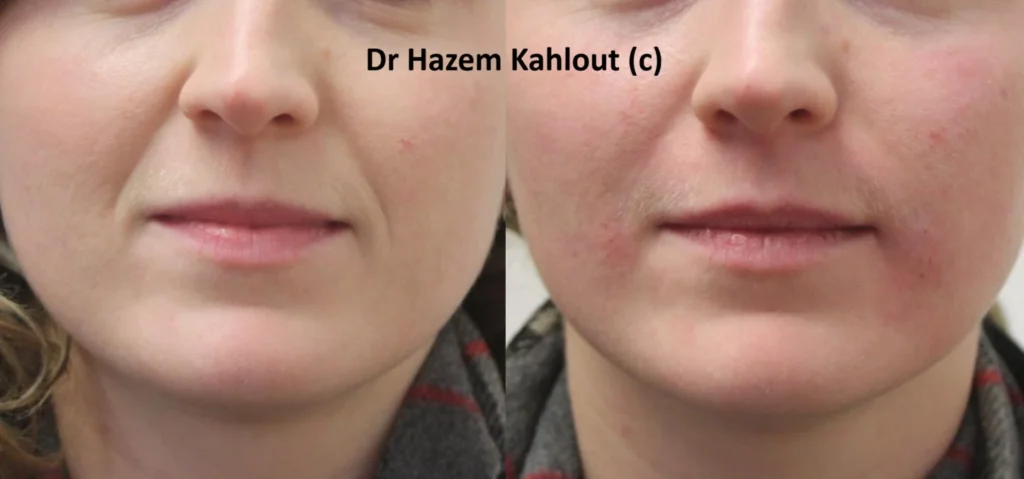
How I assess nasolabial folds
Before I suggest anything, I look at your face at rest and while you smile and talk. I check:
- how much support your cheek is giving
- whether the midface has dropped
- the support around the mouth and along the jawline
- the thickness and quality of your skin
I do it this way because filling the fold on its own often looks heavy and unnatural. Treating the cause usually gives a softer result, and sometimes means less filler in the fold itself.
Treatment options

Filler in the fold. For the fold itself I use a hyaluronic acid filler. These fillers are precise, they can be dissolved if needed, and they suit an area that moves a lot when you smile and talk. They soften the fold. They don’t erase it, and I would rather leave a little of the line than overfill it. We use fillers from the Restylane, Juvéderm, Belotero and Teoxane ranges, and I’ll explain at your consultation which one suits you.
Supporting the cheek and midface. If the fold is deep because the cheek has lost support, I often treat the cheek and midface as well, or first. A collagen-stimulating filler such as Radiesse, Sculptra or Ellansé M gives broader and longer-lasting support. Hyaluronic acid filler can also be used when you want immediate, reversible volume. Lifting the cheek takes weight off the fold, so the fold itself may need less. You can read more about cheek filler, Sculptra and Radiesse and Ellansé. These fillers are firmer than hyaluronic acid, so they suit some faces and some areas better than others.
When filler isn’t the answer. If the main problem is loose skin or heavy descent of the face, filler can only do so much. I’ll tell you at the consultation if I think filler won’t give you the result you want.
What happens at your consultation
I examine your face, talk through what bothers you, and explain what I would treat, in what order, and what it is likely to cost. You decide whether to go ahead.
Filler isn’t suitable under the age of 18, in the first six months after having a baby, or if you have a cold sore. A cold sore needs to have healed for at least a week before treatment.
Results and how long they last
Hyaluronic acid filler usually shows a difference straight away, and the final look settles over a couple of weeks once any swelling has gone. It usually lasts around 8 to 12 months in this area, depending on the filler and the person. Collagen-stimulating fillers build up more gradually and last longer, although how long varies from person to person. If you need a touch-up, I review you at about 2 to 3 weeks.

Risks and side effects
Common after treatment: swelling, redness, tenderness, bruising and small lumps. These usually settle within days. There is more on lumps after dermal fillers if you are worried about one.
Less common: uneven results, a bluish tint under thin skin, lumps that need treating, infection, and filler moving from where it was placed.
Rare but serious: filler can block a blood vessel in the area. That can damage the skin and, very rarely, affect vision.
I lower these risks by knowing the blood vessels and layers of the face in detail, by taking care with technique, by keeping a dissolving enzyme available for hyaluronic acid fillers, and by seeing you early if you are worried.
Aftercare
For the first 24 to 48 hours, avoid heavy exercise, alcohol, and very hot baths or saunas, and don’t press or massage the area unless I’ve asked you to. Swelling and bruising usually settle within a few days.
Frequently asked questions
Are nasolabial folds the same as marionette lines?
No. Nasolabial folds run from the sides of the nose to the corners of the mouth. Marionette lines start at the corners of the mouth and run down towards the chin. They often share a cause, so I assess them together. You can read more about marionette lines.
Can filler get rid of nasolabial folds completely?
No. Filler softens the fold, but I wouldn’t try to erase it. Overfilling the fold looks heavy and unnatural, and the fold is part of how a face moves when you smile.
How long does filler last in nasolabial folds?
Hyaluronic acid filler usually lasts about 8 to 12 months. Collagen-stimulating fillers last longer. It varies from person to person.
How much does nasolabial fold filler cost?
Hyaluronic acid filler starts from €300. The cost depends on the amount and type of filler, and I confirm it at your consultation. Our price list shows current prices.
Does it hurt?
Some discomfort is normal. We’ll explain what we use to keep you comfortable before we start.
Can I have nasolabial folds treated in my twenties or thirties?
Sometimes, but not always. Folds at that age are often just the way your face is built and moves. I look at what is behind them before suggesting anything, and sometimes the honest answer is that nothing needs treating.
Can I get rid of nasolabial folds naturally, or without filler?
Not completely, in my experience. Sun protection and good skin care help the skin, but they don’t replace lost volume, and I’m not aware of good evidence that facial exercises remove nasolabial folds.
Can nasolabial fold filler be reversed?
Hyaluronic acid filler can be dissolved with an enzyme if you aren’t happy with the result. Collagen-stimulating fillers can’t be dissolved in the same way, which is one reason I choose them carefully.
Book a consultation
To talk about your nasolabial folds, call 01 827 8766 or use the Book Now button. You can also read about dermal fillers in Dublin in general.
References
- Go BC, Frost AS, Friedman O. Using injectable fillers for midface rejuvenation. Plast Aesthet Res. 2021;8:39. doi:10.20517/2347-9264.2021.35