Medically reviewed and updated by Dr Hazem Kahlout, November 2026
Maybe it’s the bump you notice in every side-on photo. Or a tip that droops a little more than you’d like, especially when you talk. You’d change it if you could, but you don’t want surgery, the time off work or the risk of an operation.
For many people, a non-surgical rhinoplasty, often called a non-surgical nose job or nose filler, is the answer. I’ve been reshaping noses with filler at Castleknock Cosmetic Clinic for nearly 20 years, since long before it was a common treatment, and I carry out every one myself. Here’s what it can do, how I keep it safe, and what to expect.
What non-surgical rhinoplasty can and can’t do
Non-surgical rhinoplasty, also known as a non-surgical nose job or liquid rhinoplasty, uses small amounts of filler to change the shape of the nose. It works by adding volume in exactly the right places, so it can:
- smooth a bump on the bridge by filling the dips above and below it
- build up a flat or low bridge
- lift a drooping tip
- even out small irregularities after a minor injury
- smooth a bony ridge that sometimes forms after nose surgery, where bone meets cartilage

I don’t aim for a ruler-straight line. A nose that’s too perfect can look as unnatural as the bump did. The goal is a smooth profile that sits in proportion with the rest of your face.
What filler can’t do is make a nose smaller or narrower, because it adds volume rather than removing it. It also can’t straighten a nose that’s crooked to one side. That kind of deviation almost always needs surgery, and so do problems with breathing.
Is a non-surgical nose job right for you?
Most people with a bump, a flat bridge or a drooping tip are suitable, men and women alike. This is one of the few cosmetic treatments I see equally often in both.
Having had nose surgery before doesn’t rule you out. Some people need a revision operation but don’t want another one, and filler can sometimes smooth what surgery left behind. Small irregularities on the bridge after an injury can often be corrected too, though these noses need especially careful checks of the blood vessels first.
I won’t treat a nose that has a lot of visible blood vessels, whether from thread veins, rosacea or a skin condition such as pemphigus, because the extra blood supply raises the risk. If your nose needs surgery, such as one that’s crooked to one side, I’ll tell you honestly. I can refer you to a qualified surgeon who specialises in rhinoplasty.
If you’ve had filler in your nose elsewhere, I may still be able to help. It depends on what’s there and whether a correction can be done safely. If you know which product was used, bring the details with you.
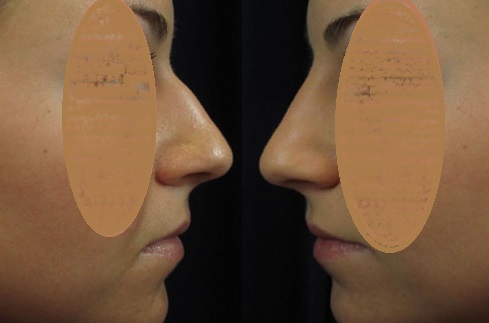
Non-surgical rhinoplasty or surgery?
Surgical rhinoplasty and non-surgical rhinoplasty solve different problems. Surgery can make a nose smaller, straighten one that’s crooked, reduce the size of the tip and improve breathing. It’s permanent, it needs a general anaesthetic, and recovery takes weeks.
Non-surgical rhinoplasty can smooth a bump, build up a flat bridge and lift a drooping tip. It takes about 15 minutes, you see the change straight away, and most people go back to work the same day. The result is temporary, so it’s also a way to see how a change suits you before deciding on anything permanent.
If filler can’t give you what you want, I’ll say so at your consultation, and I can refer you to a qualified surgeon who specialises in rhinoplasty.
Choosing the right filler
This is where experience matters most, because the filler I choose depends on your nose and on how sure we both are about the result.
When either of us has doubts about whether the treatment will give you what you’re hoping for, I use a hyaluronic acid filler. It’s a fallback, not a replacement for careful planning. If you don’t like the result, it wears off within months, and in an extreme case it can be dissolved. For the nose I use Restylane Defyne or Restylane Lyft, Juvéderm Voluma, or Belotero Balance.
When the path to a good result is clear, such as a straightforward bump with realistic expectations, or for someone I’ve treated before who wants a longer-lasting correction, I may use Radiesse or Ellansé. These are firmer and give more support, and they last longer. Sometimes they’re the right choice even for a first treatment. It depends on how your nose looks, any history of injury and what we’re trying to correct.
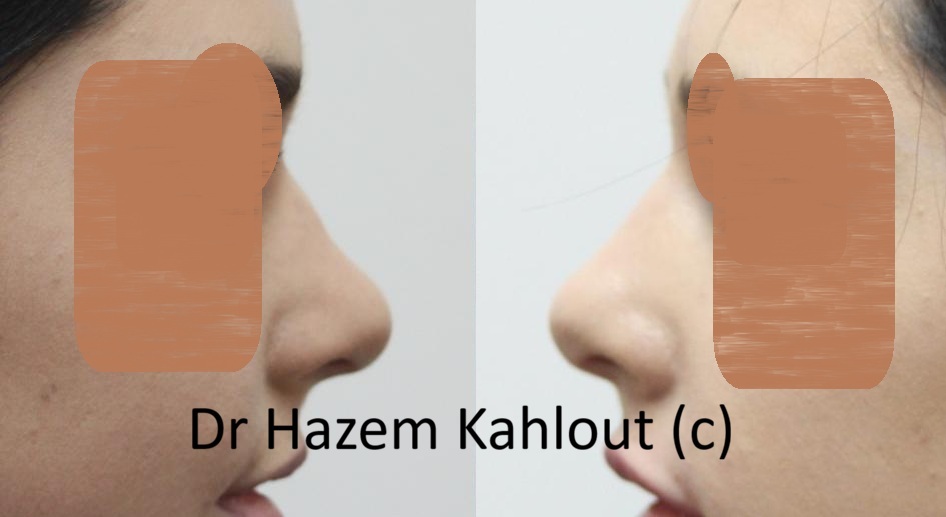
I only ever use hyaluronic acid in the tip of the nose. Radiesse and Ellansé are not recommended there.
Fillers also differ in how firm they are and how much lift they give, which doctors describe as G-prime. Firmer fillers suit the bridge, where they need to hold shape. Softer ones suit areas where a gentler change looks better.
Safety comes first
The nose has a delicate and unusual blood supply, and I treat it with that in mind every time. If filler blocks a blood vessel, either by going into it or by pressing on it, the skin it supplies can be damaged. In very rare cases, filler in a vessel near the nose can affect eyesight. These complications are uncommon, but the nose is one of the areas where they’re most likely, so it’s not a treatment to have done anywhere.
Before I inject, I map the blood vessels of your nose with a vein scope, a device that shows the vessels under the skin. I do this before every nose treatment, including top-ups, so I know where to place the filler and where to avoid. I use a fine needle or a blunt cannula depending on the area. A needle gives more precision, especially in the tip.
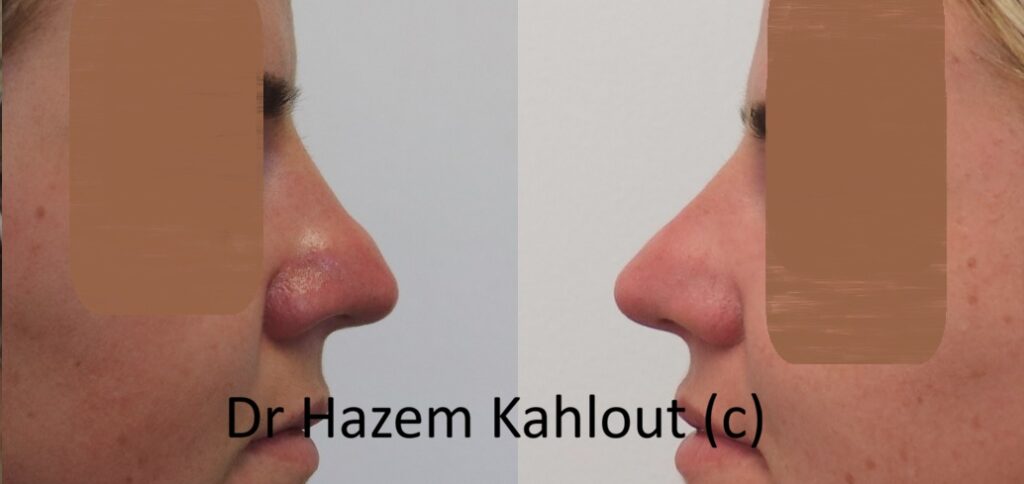
Lifting a drooping tip and the “bobbing nose”
A tip that droops, as in a Roman nose, can be lifted by placing filler in the tip and at the base of the nose, where it meets the upper lip. When it’s done well, it’s one of the most satisfying changes for both me and my patients.
At your assessment I also check for a “bobbing nose”. I ask you to pout or purse your lips, as if you’re saying the letter O, and watch whether the tip pulls down. That movement comes from a small muscle under the nose. Not everyone has it, but if you do, a small muscle-relaxing injection releases that downward pull. The tip stops dropping when you talk and sits a little higher at rest. It can be done at the same appointment as your filler.
Your appointment
The whole appointment takes about 30 minutes. The injecting itself takes around 15, which is why it’s often called the 15-minute nose job. The rest is consultation, examination, planning and safety checks.
I take photos of your nose to plan the treatment and to show you what can and can’t be achieved. They’re also a reference point for any future top-up. I can show you results from other patients with a similar nose who have agreed to share their photos, so you get a realistic idea of what to expect.
If your case is straightforward and you’re confident, we can treat you the same day. If I think you’d benefit from weighing up your options, we’ll book the treatment for another day.
The fillers I use contain a local anaesthetic that numbs the area as I work. For the first small pinch of the needle I use numbing cream or a cold spray.
Recovery and aftercare
You’ll see the change straight away. There may be mild swelling, redness or a small bruise, which usually settle within a few days, and most people go back to work the same day.
For the first 2 to 3 days:
- keep the area clean
- don’t press on, rub or handle your nose
- avoid glasses or sunglasses resting on the bridge
- be gentle when you blow or scratch your nose
- avoid strenuous exercise for the first 24 hours
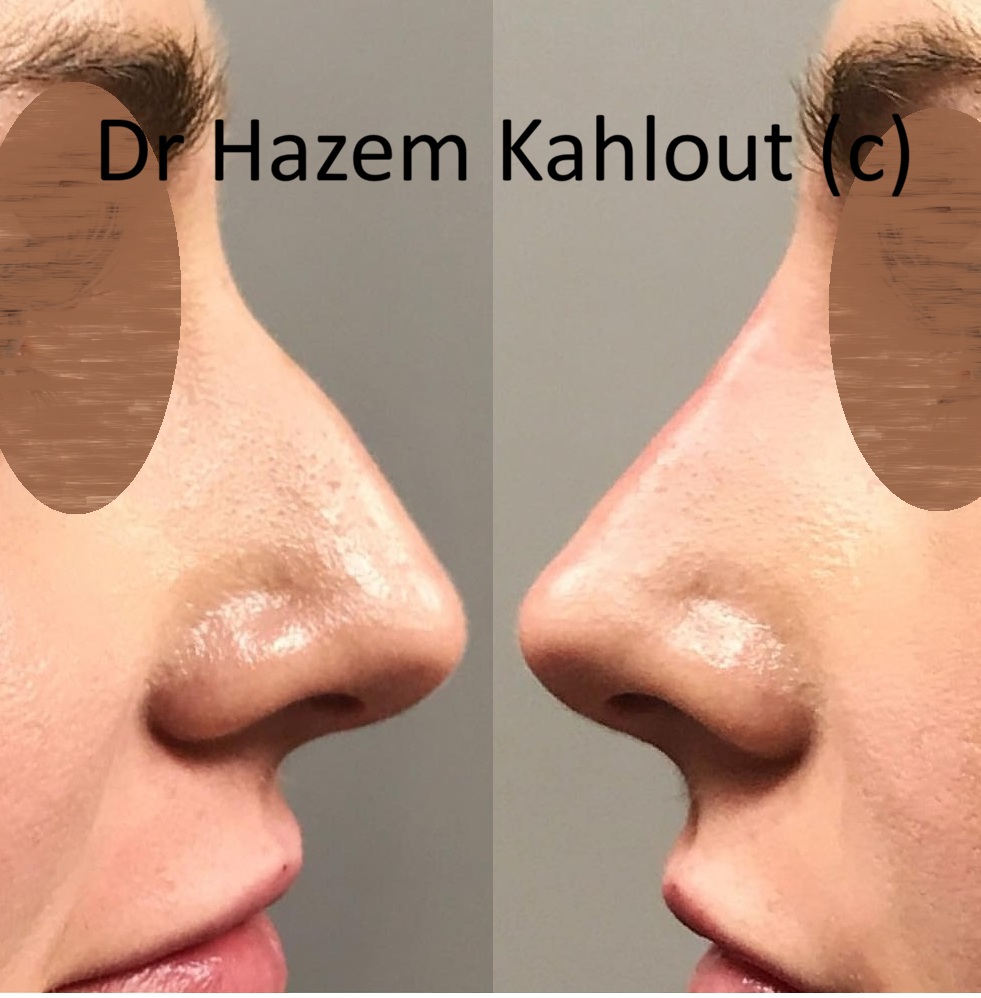
Your review
I’d like you to let things settle before deciding whether anything else is needed, both the filler and how you feel about the result. I review you at about a month. If a small correction is needed then, it’s usually included in the original price. I’ll tell you beforehand if anything would cost extra, for example treating a bobbing nose you decided not to treat first time.
How long does a non-surgical nose job last?
The bridge of the nose barely moves, which helps filler last longer here than in the lips. In my experience:
- firmer hyaluronic acid fillers last around 6 to 10 months
- softer hyaluronic acid fillers last around 3 to 6 months
- Radiesse lasts around 16 to 24 months
- Ellansé M can last more than 2 years after a single treatment
Non-surgical nose job prices in Dublin
A non-surgical nose job with hyaluronic acid filler starts from €450.
Longer-lasting fillers cost more, and you’ll find Radiesse and Ellansé prices on our cosmetic injection price list.
I’ll confirm the exact cost at your consultation once we’ve agreed which filler suits you. The muscle-relaxing injection for a bobbing nose starts from €200.
Non-surgical nose job FAQs
Is a non-surgical nose job permanent?
No. Depending on the filler, results last from a few months to more than 2 years.
Can filler make my nose smaller?
No. Filler adds volume, so it can’t make a nose smaller or narrower. It can make a nose look straighter and better balanced by smoothing a bump or lifting the tip.
Is non-surgical rhinoplasty the same as a nose job?
It’s often called a non-surgical nose job, but it isn’t surgery. It reshapes the nose with filler rather than removing bone or cartilage, so it can’t make a nose smaller. It can make it look straighter and better balanced.
Can a non-surgical nose job fix a crooked nose?
Rarely. A nose that’s bent to one side usually needs surgery. Small irregularities on the bridge after an injury can often be smoothed with filler.
Does it hurt?
Most people find it very manageable. The filler contains a local anaesthetic, and I use numbing cream or a cold spray for the first needle.
Can it be reversed?
Hyaluronic acid filler can be dissolved if needed. Radiesse and Ellansé can’t, which is why I only use them when the result is predictable.
Can I wear glasses afterwards?
Avoid glasses resting on the bridge for 2 to 3 days while the filler settles.
Can I have filler in the tip of my nose?
Yes, but only hyaluronic acid. I don’t use Radiesse or Ellansé in the tip.
If you’d like to find out whether a non-surgical nose job could work for you, book a consultation at our clinic in Castleknock, Dublin 15. I’ll examine your nose, show you what’s realistic and tell you honestly whether filler or surgery is the better option.