Medically reviewed and updated by Dr Hazem Kahlout, November 2026
Jawline filler adds structure along the jaw, so the line from chin to angle looks clearer in the mirror and in photos. I mostly use hyaluronic acid filler, which can be dissolved if the result isn’t right. Before I put any in, I look at your whole face, because a soft jawline is often not a filler problem at all.
This page covers who jawline filler suits, what I check at your assessment, what the appointment is like, how long it lasts and what can go wrong. Patients come to us for jawline fillers from across Dublin and the rest of Ireland.
Jawline filler at a glance
| Appointment | 30 to 45 minutes |
| Comfort | Numbing cream if you want it. The filler also contains a local anaesthetic. |
| Result | Visible straight away, slightly bigger while swelling settles |
| Swelling | Peaks at 24 to 48 hours and settles over 5 to 7 days |
| Review | At 4 weeks. A top-up, if needed, is included. |
| Lasts | About 12 to 18 months |
| Sessions | Most people need one. Some come back for refinement. |
| Cost | Depends on the product and the amount needed, confirmed at your assessment. See the price list. |
What people ask for when they book jawline filler
Most of the women who book are between 30 and 50. They tell me their jaw looks soft in photos, or that the line drops off before the jowl. They want it sharper and more defined. Few ask for a V-shape now. What they want is a clean line from chin to angle.
More men are booking, usually between 25 and 45. They ask for a stronger, more chiselled jaw, or more width at the angle. Many train in the gym and want the result to match a lean build.
After 50 the usual complaint is jowls and loose skin. Filler can’t tighten skin, so I often talk to these patients about a lift instead.
The words you use tell me what you want the result to look like, and whether filler can give you that.
Is it your bone, muscle, fat or skin?
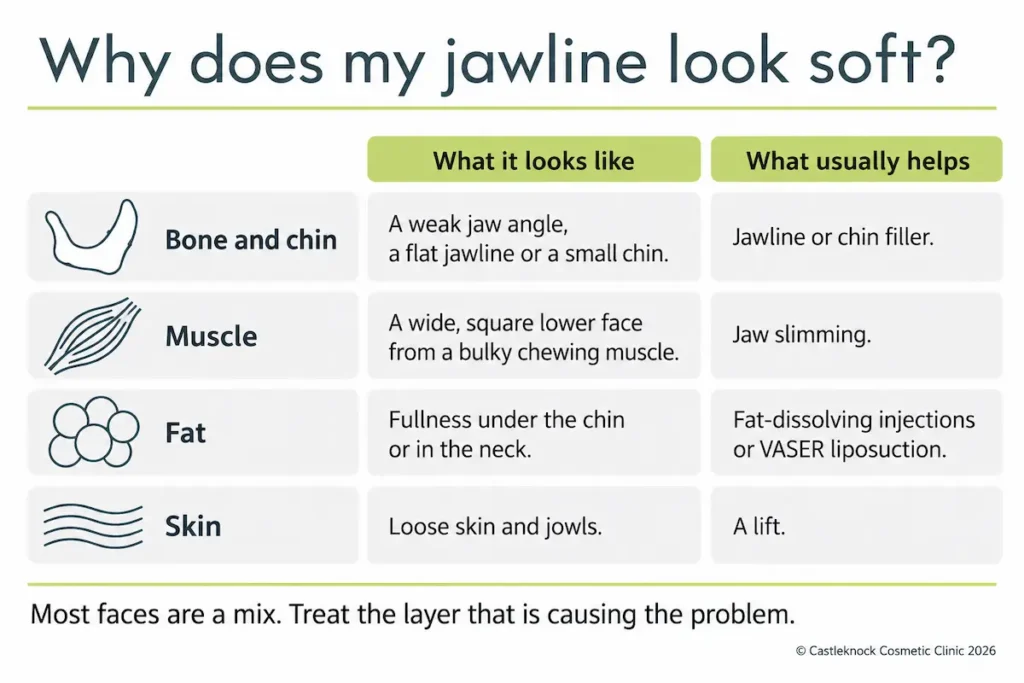
A soft or heavy jawline usually comes from one of four layers, and sometimes from several. I diagnose the layer and treat that layer. Filler shouldn’t be asked to fix a problem that sits somewhere else.
At your assessment I look at these, in this order:
- Your facial proportions: the three thirds of the face, and how wide your jaw is compared with your cheekbones and the height of your face. A narrow jaw with high cheekbones needs a different plan from a wide, heavy lower face.
- The angle of your jaw and your chewing muscle (the masseter). A bulky muscle can hide a weak jaw angle or make the jaw look wide, and filler over it makes the face wider still.
- The soft tissue: skin thickness, fat under the chin, jowls and how loose the skin is.
- Your chin and your bite: how far the chin projects, the groove in front of the jowl, and any bite problem.
Then I match what I find to a treatment:
| What I find | What usually helps |
|---|---|
| A weak jaw angle, flat jawline or small chin, with good skin | Jawline filler, with chin filler if the chin needs it |
| A wide, square lower face from a bulky chewing muscle | Jaw slimming |
| Fat under the chin or in the neck, with skin that still springs back | Fat reduction under the chin, including neck and chin VASER liposuction |
| Loose skin and jowls | A lift, such as a mini facelift or J-Plasty. Filler adds support but doesn’t tighten skin. |
| A bone or bite problem | A referral to a dentist or a jaw surgeon |
Most faces are a mix. When they are, I combine treatments in order, as described below.
Men and women are shaped differently
For women I aim for a smooth, continuous line from chin to angle, with a subtle angle and a slight taper. Too much width at the angle squares the face and makes it look more masculine, so I keep it light. I also watch the length of the chin, because a long chin makes the lower third of the face look long.
For men the emphasis moves to the angle and the width of the jaw. The aim is a wider, more angular lower face and a broader, squarer chin. Even then I avoid lengthening the chin, which looks out of proportion on any face.
When the problem is fat under the chin or in the neck
If the heaviness comes from fat under the chin and the skin still springs back when I pinch it, filler on its own won’t give you a defined jawline. Adding volume around a fuller neck can make the whole lower face look bigger, so I treat the fat first.
For smaller pockets of fat I use fat-dissolving injections. For more fat I use VASER liposuction, which uses ultrasound energy to loosen the fat before it’s removed and can help tighten mildly loose skin. It’s done at the clinic under local anaesthetic. If the skin is very loose, liposuction alone leaves loose tissue behind, and a lift is the better route. The double chin guide goes through the options.
Sometimes the neck muscle is pulling the jawline down rather than the bone losing support. In that case a Nefertiti lift may be part of the plan.

Combining treatments, and in what order
Combining is common, and the order matters because the face changes shape as it settles. If you need fat reduction, I do that first, let the tissue settle and add filler 6 to 8 weeks later. If a bulky chewing muscle is part of the picture, I treat the muscle first and add filler about 4 to 6 weeks later. I’d rather work in stages than ask one treatment to fix a problem that has several layers. Loss of support along the jaw is also behind many marionette lines, which is why I assess them together.
Which fillers I use
I mostly use hyaluronic acid fillers, such as Restylane Lyft and Juvéderm Voluma. I also use non-hyaluronic fillers, Radiesse and Ellansé M, in some patients. Unlike hyaluronic acid filler, these can’t be dissolved with a dissolving enzyme, so we agree the choice at your assessment.
What happens at your appointment
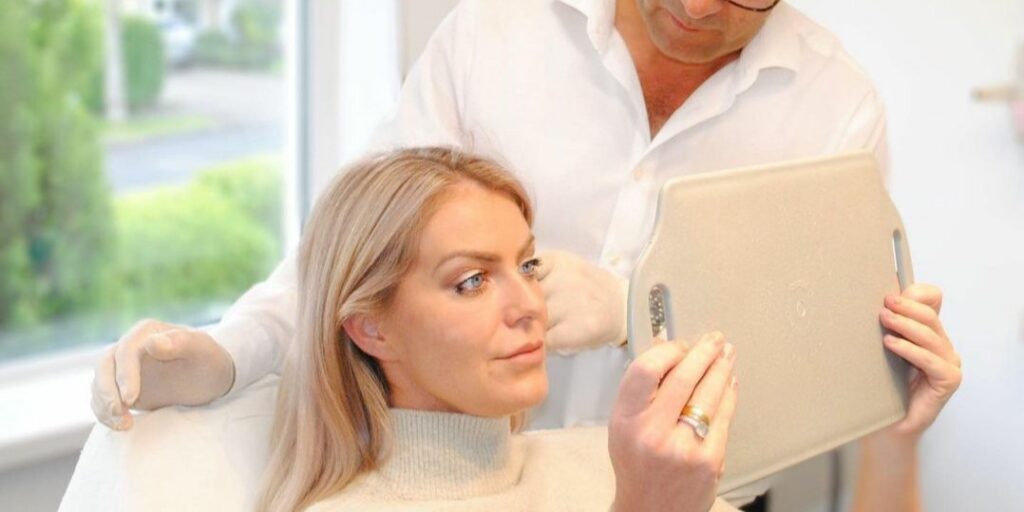
The appointment takes 30 to 45 minutes. The first 10 to 15 minutes are for consent, photographs from the front, the side and an angle, and marking your face. I mark the midline, the angles of the jaw and the groove in front of the jowl, and we agree the plan together with a mirror in your hand.
If you’d like numbing cream, it goes on for 10 to 15 minutes beforehand. Most patients tolerate jawline filler well. The injections take about 10 to 15 minutes. I build the shape in small steps and check symmetry as I go.
Afterwards: what to expect and your review
You’ll see a result straight away. It often looks slightly bigger at first because of swelling. For 48 hours, avoid strenuous exercise, alcohol and facials. Sleep with your head slightly raised and use ice on and off for the first 24 hours. Avoid dental work for two weeks before and two weeks after treatment.
Swelling peaks at 24 to 48 hours and settles over 5 to 7 days. Some patients bruise. It’s usually mild, fades over 5 to 7 days and can be covered with make-up.
I review you at 4 weeks, once the swelling has gone and we can judge the real result. I don’t top up before then. I aim to get it right the first time, but on rare occasions a top-up is needed, and if it is, it’s included. If the result looks heavy, I’d rather dissolve some filler than add more, and that’s rare in my practice. Most patients need one session. A smaller number come back for refinement.
How long does jawline filler last?
Most patients keep a visible result for about 12 to 18 months, and it fades gradually rather than all at once. A fast metabolism, intense exercise and smoking can shorten that. In very active patients I see it nearer 9 to 10 months. Good skin quality and a stable weight help it last longer.
Most people come back at about 12 months. I’d rather top up before the filler has fully gone, because it takes less product to restore the shape than to start again. I treat maintenance as a yearly review. We decide at the review whether you need anything, so you don’t have to pre-book a fixed schedule.
What can go wrong with jawline filler
Jawline filler is widely used, and it still carries risks. These are the ones I think about most, and what I do about each.
A heavy, square or longer-looking jaw
The jaw moves constantly, and over time that can nudge filler out of place, so the chin looks longer or the lower face looks bulky. This is the most common problem. I prevent it by building structure first and volume second, and by treating in stages. If someone already looks heavy, I dissolve some filler before I add any.
Lumps
Small lumps are common and usually mild, and they settle within about two weeks. Putting a large amount in one spot makes lumps more likely, so I spread the filler out and don’t over-correct in one session. A lump that doesn’t settle can be dissolved. There’s more in our guide to lumps after dermal fillers.
Swelling weeks or months later
This is rare. Swelling can return weeks or months after treatment, sometimes after an infection, a vaccination or dental work. A 2024 expert consensus on late-onset reactions to hyaluronic acid filler lists recent dental treatment among the recognised risk factors. I ask about your dental history, and I ask you to avoid dental work for two weeks either side of treatment. If a reaction happens, it’s treated.
A blocked blood vessel
This is rare, and it’s the risk I take most seriously. If filler blocks or presses on a blood vessel, the skin that vessel supplies can be damaged. The warning signs are severe pain, skin that turns white, grey or blotchy, or any change in your vision. If you notice any of these, call the clinic straight away on 01 827 8766. If you can’t reach us, go to your nearest emergency department. Treating early with a dissolving enzyme is what limits the damage.
Uneven swelling and asymmetry
Early swelling is rarely even. I photograph you before treatment, mark the midline, and review you at 4 weeks before I touch anything up.
Who I’d delay or decline
Some people should wait or shouldn’t have jawline filler at all:
- Pregnancy and breastfeeding. There isn’t enough safety information, and filler isn’t urgent, so we revisit it afterwards.
- Dental work in the last two weeks, or any dental infection. The infection is treated first.
- Expectations filler can’t meet, such as a surgical result, a major change to bone or tightening loose skin. Adding more won’t fix these, and chasing them leads to overfilling.
- Bleeding disorders and autoimmune conditions. I don’t decline these automatically. I plan treatment with your doctor, choose a reversible filler and talk you through bruising and delayed reactions.
If the real problem is bone, a bite problem or very loose skin, I’ll refer you on or suggest a different treatment. I’m honest about what injectables and liposuction can’t do.
How much does jawline filler cost in Dublin?
The cost depends on the product and how much you need to shape your jaw, and I confirm both at your assessment. Current prices are on the price list.
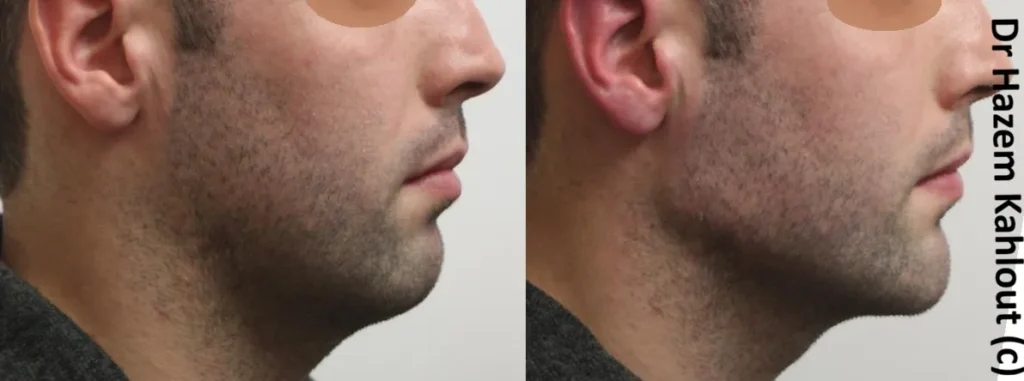
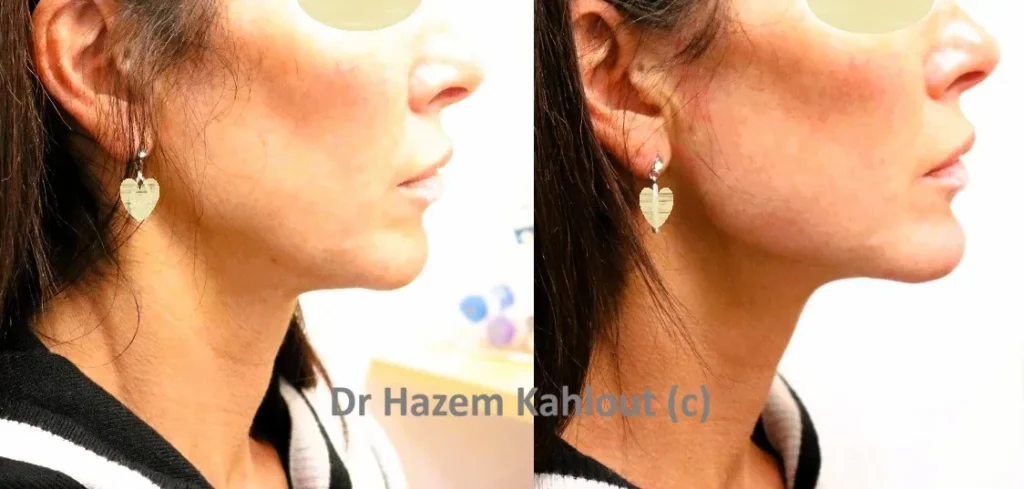
Jawline filler before and after
These are my own patients, photographed unedited and shared with their consent. The woman in her 40s also had cheek filler.

Your doctor
I’m Dr Hazem Kahlout. I have more than 25 years of experience with dermal fillers. I trained through many courses early in my career, and I still attend refresher workshops at international aesthetic congresses. I also train the new doctors who join the clinic.

Jawline filler FAQs
Does jawline filler hurt?
Most patients tolerate it well. You can have numbing cream first, and the filler itself contains a local anaesthetic.
Will jawline filler make my face wider or more square?
Only if it’s used for the wrong problem. A bulky chewing muscle can make the jaw look wide, and filler over it widens the lower face further, so I check for that first. If a result looks heavy, I can dissolve some of the filler.
Can jawline filler fix jowls or a double chin?
Filler suits mild to moderate loss of contour and volume. It can’t tighten loose skin, and it doesn’t remove fat. For significant looseness I’d talk to you about a mini facelift. For a double chin I’d look at fat-dissolving injections or VASER first.
Jawline filler or jaw slimming?
They solve opposite problems. Filler adds structure to a jaw that has softened. Jaw slimming reduces bulk in a wide, square jaw, and a simple clench test gives a clue about which one you need. I confirm it at your assessment.
Jawline filler or chin filler?
Often both. A small or recessed chin makes the jawline look weaker, so I look at the chin first. See chin filler.
Can jawline filler be dissolved?
Yes. Hyaluronic acid filler can be broken down with a dissolving enzyme if the result isn’t right. That’s one reason I use it.
What should I avoid after jawline filler?
For 48 hours, avoid strenuous exercise, alcohol and facials. Sleep with your head slightly raised and use ice on and off for the first 24 hours. Avoid dental work for two weeks before and after treatment.
Is jawline filler suitable for men?
Yes. Men usually want a different shape, with more width at the angle and a squarer chin, and I plan the result around your face and your goals.
Book a jawline assessment
If you’d like to know whether jawline filler is right for your face, book an assessment at Castleknock Cosmetic Clinic, Dublin 15. We’ll look at your bone, muscle, fat and skin, and tell you honestly if filler isn’t the answer.
Related Treatments
References:
- Late-onset reactions after hyaluronic acid dermal fillers: a consensus recommendation on etiology, prevention and management. Dermatology and Therapy (Heidelb) 2024;14(7):1767-1785. PubMed
- Using injectable fillers for chin and jawline rejuvenation. World Journal of Otorhinolaryngology, Head and Neck Surgery, 2023. Full text