Medically reviewed and updated by Dr Hazem Kahlout, November 2026
A split, stretched or drooping earlobe can be repaired in a short procedure under local anaesthetic. I have repaired earlobes for more than 15 years at Castleknock Cosmetic Clinic in Dublin 15. My patients come with lobes torn by earrings, piercings that have stretched into a slit, gauges that left a hole which won’t close, and lobes that have grown longer with age.
The right repair depends on which of these you have. This page explains each one, what I check at your consultation, what recovery is like, and where things can go wrong. A simple repair on one earlobe starts from €650.
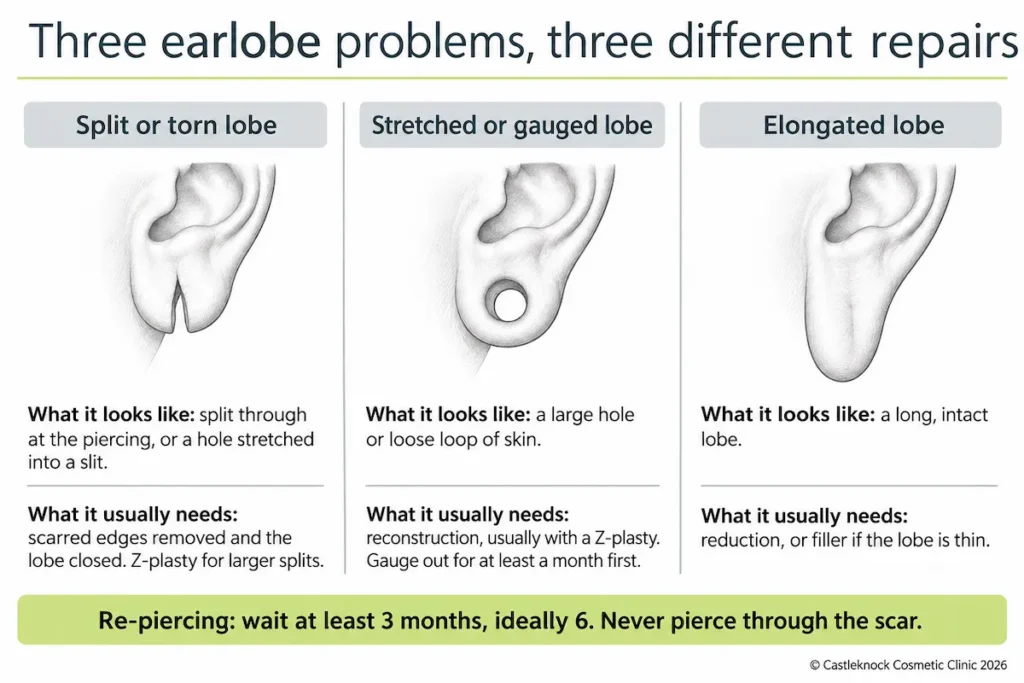
Which problem do you have?
| Problem | What it looks like | What it usually needs |
|---|---|---|
| Split or torn lobe | The lobe is split through at the piercing, or the hole has stretched into a slit | The scarred edges are removed and the lobe is closed. A Z-plasty is used for larger or complete splits |
| Stretched or gauged lobe | A large hole, or a loop of loose skin, left by gauges or years of heavy earrings | Reconstruction, usually with a Z-plasty, once the gauge has been out for a period of time |
| Elongated lobe | A long or droopy lobe that is still intact | Reduction, where a small wedge is removed. A thin, ageing lobe may suit filler instead |
If you aren’t sure which one you have, come in for a consultation. It is usually obvious once I see the lobe.
Split or torn earlobe repair
Most of the people I see for this are women in their 20s to 50s. Many have hidden the damage for months or years, and they tell me they’ve stopped wearing their hair up or stopped wearing earrings altogether. A smaller group are women who recently caught an earring on a towel or jumper and tore it through. Men come too, usually after an injury.
A split lobe has a few causes. Heavy or long earrings pull on the piercing over years until the hole stretches into a slit and finally tears through. Or one sudden pull does it in a second. Others have repeated small damage from pulling tight-necked tops on and off while wearing earrings. If it has just happened, my guide to what to do after an earring tears through covers the first hours.
A torn earlobe won’t heal on its own. Once the skin has torn right through, each edge heals over separately and the gap stays open. Skin glue or tape may hold the edges together for a few days, but they won’t fuse. To close the lobe, I remove a thin strip of the healed skin along both edges so the two raw surfaces can knit together, then close the lobe in layers.
For a small split, a straight closure often does the job. For a complete split or a larger defect, I use a Z-plasty. This breaks the scar into a zigzag, which reduces the tendency of a straight scar to tighten and pull the edge of the lobe upwards. I explain below why that matters.
Stretched and gauged earlobe repair
A gauge stretches the lobe around a tunnel of skin. Take the jewellery out and the tunnel often stays open, because the tissue has lost its elasticity and the hole is lined with skin that won’t close by itself. Many of the people I see for this are men in their 20s to 40s who have changed jobs or their style. Women with lobes stretched by years of heavy earrings come too.
The question I hear most is whether it will close on its own. A small stretch may tighten a little. A larger tunnel won’t close fully without surgery.
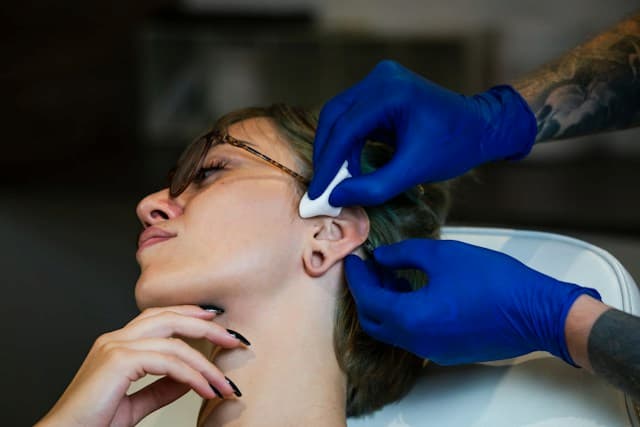
I ask you to leave all jewellery out for a while before the repair, so the tissue can contract and there is less to rebuild. The repair usually needs a Z-plasty to rebuild a natural, rounded lobe. The bigger the gauge, the more reshaping is needed and the longer the scar.
If you plan to keep wearing large gauges, a repair may not be worth doing, and I will tell you so. Very large tunnels change the shape of the ear too much to give a natural-looking lobe again.
Gauged lobes are the least common problem I see. In a 2021 case series of 53 people who had gauged earlobes repaired at one US centre, about 1 in 9 needed a minor revision for asymmetry or scarring.
Elongated earlobe reduction
An elongated lobe is still intact, so this is a different surgical procedure from a repair. Earlobes get longer with age because the skin loses its elasticity and gravity pulls on it, and heavy earrings make it worse. People tell me they don’t want anything fancy. They want the lobes smaller and natural-looking again.
I remove a small wedge of tissue to shorten or reshape the lobe, usually placing the scar in the natural crease where the lobe meets the cheek so it stays discreet. It is done under local numbing, and both ears often take under an hour. Recovery is much the same as for a repair.
These are my own patients, photographed unedited and shared with their consent.
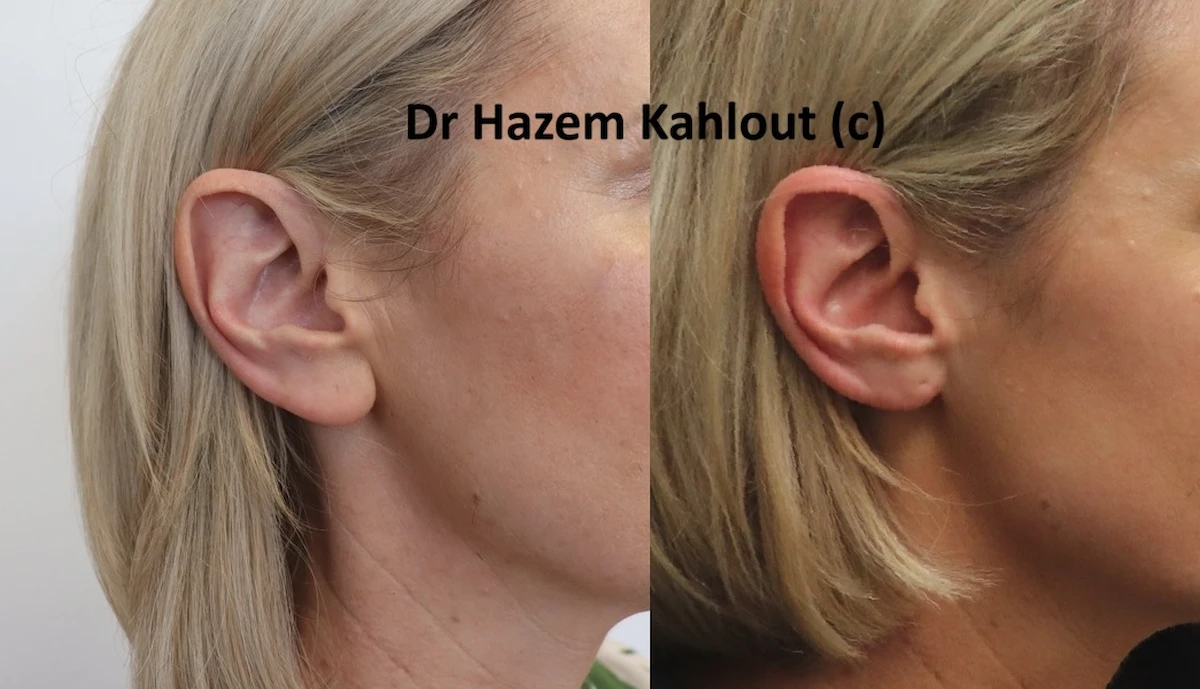
The scar is a permanent trade for a smaller lobe, and I’d like you to be comfortable with that before we start. Ears are rarely identical beforehand, so I mark and treat each one separately. I can’t promise perfect symmetry, and I tell everyone that at the consultation.
Filler for thin, droopy earlobes
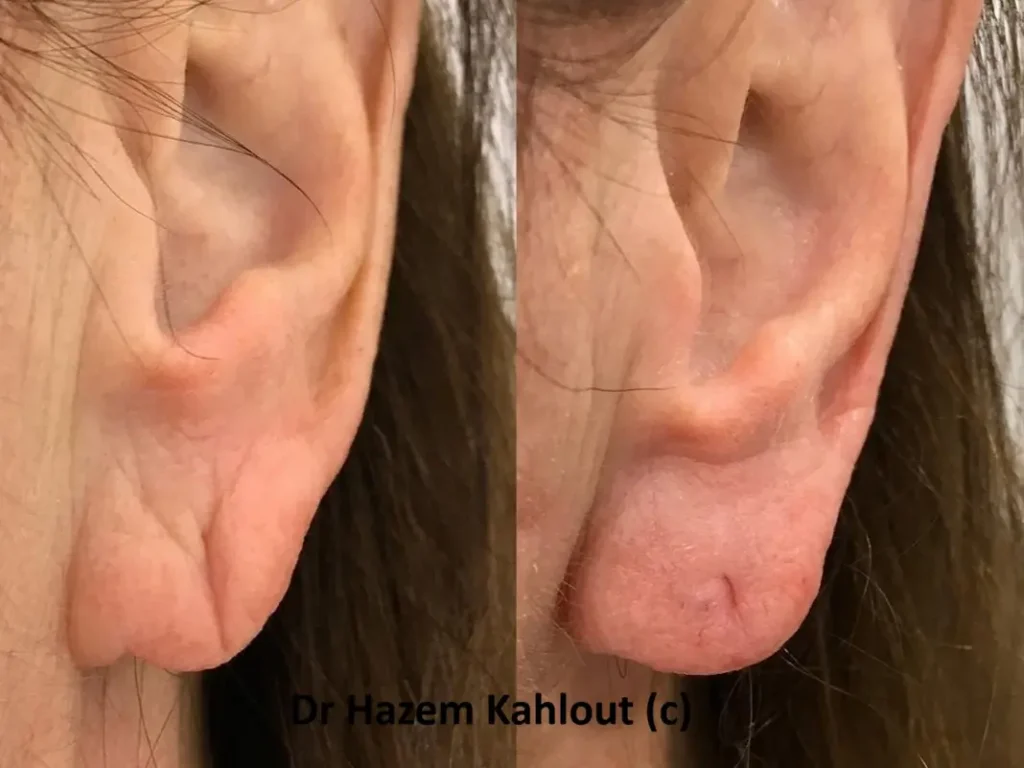
If your lobe is intact but thin and sagging, a small amount of hyaluronic acid filler can restore some volume and contour. It can also support a stretched piercing hole so that earrings sit forward instead of hanging down.
Filler has limits. It can’t close a split and it can’t shrink an enlarged hole. It adds volume to a lobe that is otherwise intact. If your lobe is split or the hole is large, you need surgery. Filler for the earlobes starts from €450, and I confirm the exact price at your consultation.
Can earlobe repair be done without surgery?
No. Nothing you put on your ear will permanently close a split or a stretched hole. Once a tear has healed, each edge is covered with mature skin, and two skin-covered surfaces won’t join, whatever you apply.
Skin glue may hold the gap shut for a few days. Earring support patches can take the weight off a stretched but intact lobe for an evening, and they are worth trying for an event. Both are temporary. Please don’t use household superglue, because it irritates the skin and makes the repair harder.
What happens at the consultation and the procedure
At the consultation I look at the lobe and the quality of the skin, and I check how thick the scar tissue is. I ask whether you or anyone in your family tends to get keloid or raised scars, and whether you want to wear earrings again afterwards. All of that changes the plan. If we go ahead, I book you into the procedure room for a later appointment. I don’t repair on the day of the consultation.
For each earlobe, a simple repair takes 30 to 45 minutes and a Z-plasty 45 to 60 minutes, including the time the local anaesthetic needs to work. It is done under local anaesthetic only, with no sedation, and you go home straight afterwards with a small dressing.
The deeper layer of the lobe, which takes the tension, is closed with dissolving stitches. On the surface I use either dissolving stitches or very fine removable ones, depending on your lobe. Removable stitches give the finest scar on the visible edge, and dissolving ones mean nothing to take out. I see you again at 2 to 3 weeks, and I take out any stitches that are still there.
Recovery after earlobe repair
Expect some tenderness and swelling for a few days. Keep the area clean and dry for 48 hours, then you can shower gently and pat it dry. Most people are back at work within 1 to 2 days.
Avoid strenuous exercise and heavy lifting for 2 to 3 weeks. Keep hair dye and heavy styling products away from the ear until it has healed.
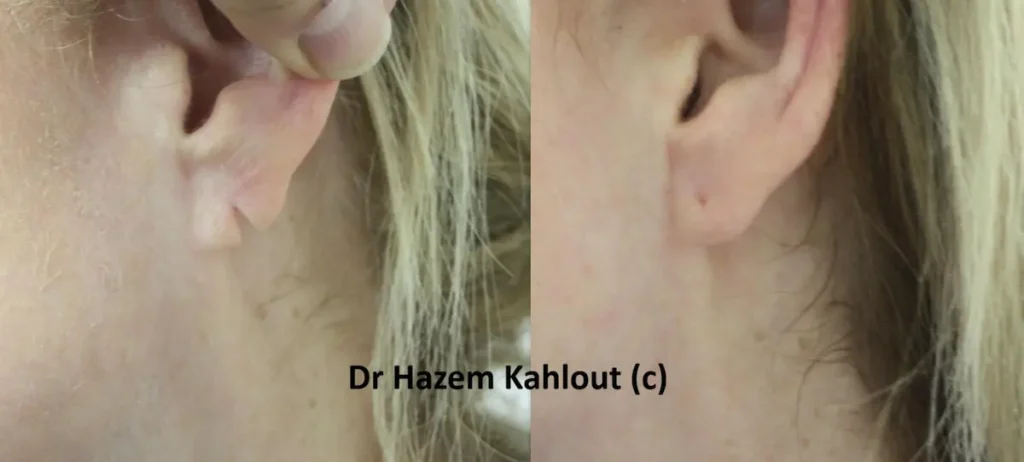
The scar is a fine line that fades over the following months. Most lobes look settled by three to six months.
These are my own patients, photographed unedited and shared with their consent
When can I get my ears pierced again?
Wait at least three months, and preferably six. That gives the scar time to mature and regain its strength.
Never pierce through the scar. The new hole should go in healthy skin slightly to one side of the repair. Go to a professional piercer and avoid piercing guns, and start with a light stud in titanium or surgical steel. Heavy hoops and long dangling earrings can tear the lobe again.
What can go wrong
Earlobe repair is a small operation, but it is surgery, and these are the risks I go through with every patient:
- A scar that thickens or turns raised (keloid), which is more likely if you or your family are prone to it
- Infection
- Bleeding and swelling
- The wound opening if the lobe is pulled before it has healed
- Asymmetry between the two ears
- A minor revision to improve the scar or the shape, which some patients need
A notch in the lobe
A notch is a small dip in the lower edge of the lobe, often heart-shaped. It is the complication I plan most carefully to avoid, because you can see it.
A notch is almost always a scar problem. A straight scar tightens as it heals and pulls the edge of the lobe upwards. That is why I use a Z-plasty for larger splits, and why I place the stitches so the tension sits away from the edge of the lobe. Piercing too early, or wearing heavy earrings before the lobe has regained its strength, can make a notch more likely or more obvious.
If one appears, a mild notch often softens over the following months. A notch that stays is usually improved with a small revision, normally another small Z-plasty or a notch correction.
Notching is uncommon after a simple repair. In a 2013 series of 192 patients repaired at a hospital in North Gujarat, India, one had notching of the lower edge and one had a depressed scar.
When I delay a repair or refer you
I delay the repair if the lobe is infected or inflamed, until it has calmed down. If you are still wearing a gauge, I ask you to leave it out for at least a month first. Smokers heal more slowly because nicotine impairs healing, so I ask you to stop at least four weeks beforehand.
If you have had keloid scars, repair is not ruled out, but it changes the plan. I talk honestly about the risk of the scar coming back, and I may add extra scar treatment alongside the surgery.
An active keloid, damage that involves the cartilage, or significant tissue loss needs a more complex setting or a combined scar plan, and I will refer you instead.
How much does earlobe repair cost in Ireland?
A simple repair on one earlobe starts from €650. A Z-plasty costs more, because it takes longer and involves more reshaping, and gauge repairs usually need one. If both ears need work, I plan them together.
I give you the exact price at your consultation, before anything is booked. You can also spread the cost with Humm finance.
Your questions about earlobe repair
Does earlobe repair hurt?
You will feel the injection of local anaesthetic for a few seconds. After that the lobe is numb, and most people feel pressure rather than pain. It is usually tender for a few days afterwards.
How long does earlobe repair take?
For each earlobe, a simple repair takes 30 to 45 minutes and a Z-plasty 45 to 60 minutes. You go home straight afterwards.
Can a split earlobe heal on its own?
No. Once the skin has torn through, each edge heals over separately and the gap stays open. Tape and glue won’t close it. To bring the edges together I remove a thin strip of the healed skin, so two raw surfaces can knit.
When can I go back to work?
Most people are back at work within 1 to 2 days. Avoid strenuous exercise and heavy lifting for 2 to 3 weeks. I see you again at 2 to 3 weeks.
When can I get my ears pierced again?
Wait at least three months, and preferably six. The new piercing should go slightly to one side of the scar, and please don’t let anyone use a piercing gun.
Will there be a scar?
Yes, a fine line that fades over the following months. Where a straight scar would risk pulling the edge of the lobe upwards, I use a Z-plasty to break up the line.
Can stretched or gauged earlobes be repaired?
Yes. A larger hole needs more reshaping than a simple tear, and I usually use a Z-plasty to give you a natural, rounded lobe. Leave the gauge out for at least a month beforehand. If you intend to keep wearing large gauges, tell me, because that changes whether repair makes sense.
References
- Scott BL, Anderson Y, Loyo M, Kim MM. Repair of gauged earlobes: case series and review of two techniques according to size. J Cutan Aesthet Surg. 2021;14(3):351-356. PMC8611704
- Khilnani AK, Thaddanee R. Clinical and demographic profile of cases requiring ear lobe repair in North Gujarat. Natl J Med Res. 2013;3(2):140-142. Full text