Medically reviewed and updated by Dr Hazem Kahlout, November 2026
People who ask me about Profhilo usually want a natural refresh. Their skin has started to look dull, dry or a little crepey, and it doesn’t bounce back the way it did. They want it firmer and more hydrated, but they don’t want added volume or a different face shape.
Profhilo can do that for the right skin. It improves skin quality: hydration, firmness, texture and tone. It doesn’t lift sagging skin or replace lost volume, and being clear about that from the start is what makes patients happy with it. I carry out every Profhilo treatment myself at the clinic in Castleknock, Dublin 15, and patients come to us from as far as Galway, Limerick and Cork.
| Profhilo at a glance | |
|---|---|
| Product | Profhilo, made by IBSA |
| What it improves | Hydration, firmness, crepey texture, tone and elasticity |
| What it doesn’t do | Lift sagging skin or replace lost volume |
| Areas | Mainly the face; also the neck, décolletage and hands |
| Course | 2 to 3 sessions, about 4 weeks apart |
| Full result | About 4 weeks after the last session, still improving up to about 8 weeks |
| How long it lasts | About 6 months on average (4 to 9 months in my patients) |
| Cost | From €350 a session (price list) |
What Profhilo is
Profhilo is a hyaluronic acid injectable made by IBSA, an Italian pharmaceutical company. Each 2ml syringe holds 64mg of hyaluronic acid. The manufacturer bonds two forms of hyaluronic acid together with heat, one with long chains and one with short chains, which gives a gel fluid enough to spread through the skin from a small number of injection points.
Profhilo isn’t a filler. Fillers are firmer gels placed to build up or shape an area, such as the cheeks or lips. Profhilo spreads out under the skin instead. As well as hydrating the skin, it’s thought to encourage the skin to make more collagen and elastin, which is why the firming effect builds over weeks rather than showing straight away.
Who Profhilo suits
When I examine people who ask for Profhilo, I usually find dry or dehydrated, dull skin with early fine lines, a crepey texture and mild laxity. The skin often looks tired, with uneven tone and less elasticity. Most are over 30, and there’s usually very little volume loss.
The first thing I do is confirm that your concern is skin quality and not volume. Profhilo is a good choice if you have:
- skin that looks dull, dry or tired despite a good skincare routine
- a crepey texture, especially on the lower face or neck
- early softening along the jawline or cheeks
- skin that has lost its bounce
It isn’t the right treatment for significant sagging, deep creases or hollows. For those, I’d look at a liquid facelift or a collagen stimulator such as Sculptra or Radiesse instead.

Is Profhilo worth it?
For the right person, yes. My happiest Profhilo patients are usually over 30, with skin that has become dull, dehydrated, slightly crepey or mildly lax. They want to look fresher, and they understand that Profhilo improves the skin itself without adding volume or lifting.
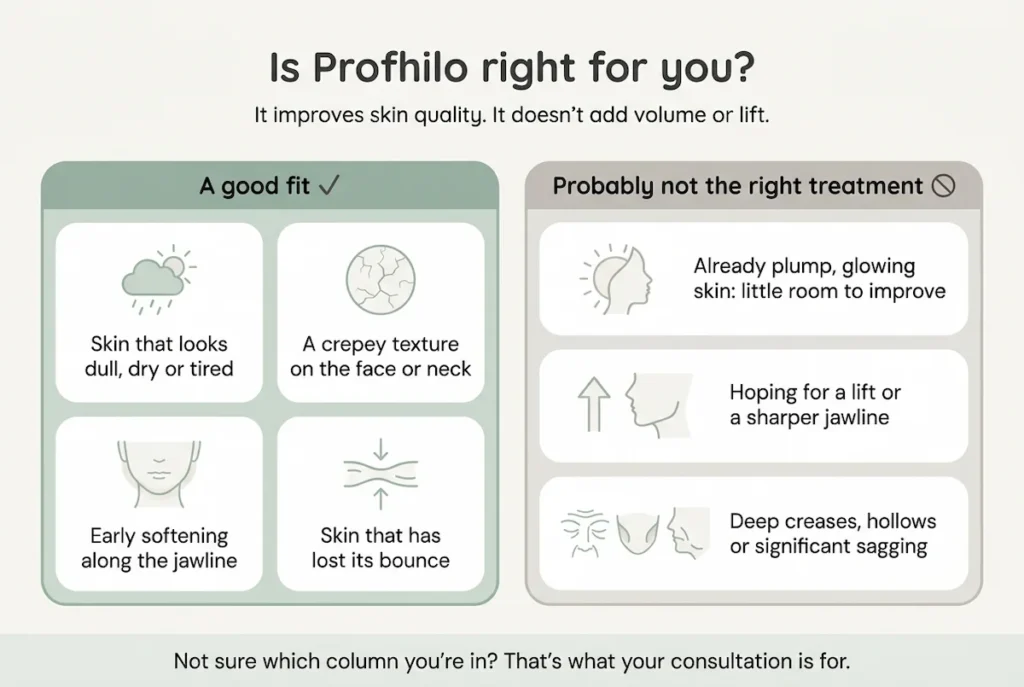
When patients are disappointed, they nearly always fall into one of three groups:
- Younger people whose skin is already plump and reflective. There’s little room for improvement, so they see little change.
- People who expected a lift, such as a sharper jawline or higher cheeks. Profhilo doesn’t correct structural sagging.
- People with significant laxity, deep creases or volume loss. They need a different treatment altogether.
In almost every case the problem is the expectation, not the product. That’s why I spend time at the consultation on what Profhilo will and won’t do before the first injection.
When I postpone or say no
I’ll ask you to wait, or suggest a different treatment, in these situations:
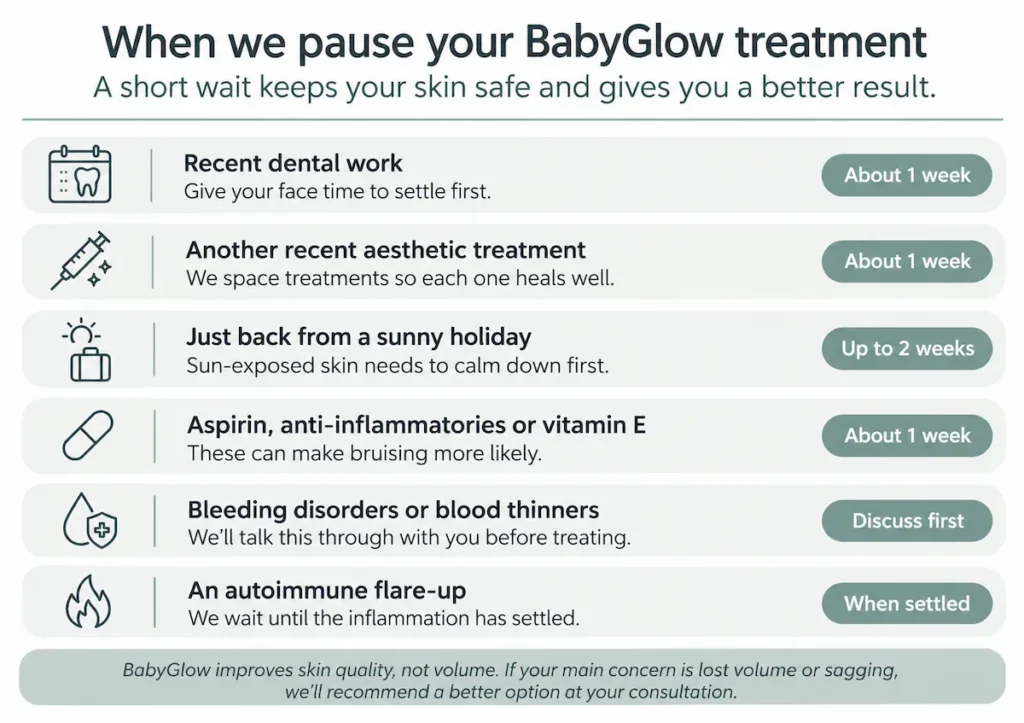
- dental work or another aesthetic treatment in the last week
- a sunny holiday in the last 2 weeks
- aspirin, anti-inflammatories or vitamin E in the last week, as these make bruising more likely
- a bleeding disorder or blood-thinning medication, which we’ll talk through first
- an autoimmune flare-up, until the inflammation has settled
- a tendency to form keloid (raised) scars
- permanent filler from a previous treatment in the area
- expectations Profhilo can’t meet, or a main concern of lost volume or significant sagging
How a course of Profhilo works
A standard course is 2 sessions about 4 weeks apart. I add a third session for more advanced laxity, or when we’re treating the face and neck together.
I place Profhilo using the BAP (Bio Aesthetic Points) technique, the standard method developed for this product. It uses a small number of set points where the gel spreads evenly through the surrounding skin.
After the course, a single top-up at about 6 months keeps the result going. I adjust the timing to how your skin responds.
Profhilo for the neck
Most people come to me about their face, but the neck is one of the main areas Profhilo is used for. It’s often where crepey skin and horizontal lines show first. I sometimes treat the neck alongside the face in the same course. The décolletage and the backs of the hands can be treated too, if your goals go beyond the face.
Profhilo or BabyGlow?
I choose after examining your skin, not by the name of the product you ask for. If laxity, crepiness or loss of bounce is the main problem, and you’re happy for the result to build over a few weeks, Profhilo is usually the better fit. If dullness, dehydration or surface texture leads and your skin tone is still fairly good, BabyGlow gives a visible glow sooner. When someone has both, I may plan the two treatments across the year. If you’re not sure which skin booster suits you, my skin boosters guide compares all the options I offer.
On the day and afterwards
Each injection feels like a small sharp scratch followed by a little pressure as the gel spreads. I can apply a numbing cream beforehand if you’d like.
Small raised bumps appear where the product was placed. They’re expected and settle as the gel spreads, usually within a day or two. Please leave them alone.
For 24 to 48 hours afterwards, avoid:
- rubbing or massaging the treated area
- heat, such as saunas, steam rooms and hot yoga
- alcohol
- exercise
Every patient goes home with my written aftercare sheet.

Risks and side effects
The most common reactions are bruising, temporary swelling, redness, tenderness and the small bumps at the injection points. They usually settle within a couple of days.
Lumps that last longer than a week are less common, but they are reported. The rarest serious risk with any facial injection is a blocked blood vessel (vascular occlusion). With Profhilo, I pay particular attention to where the blood vessels run and watch for warning signs during and after every treatment, so anything unusual is treated straight away.
A review of 3 years of worldwide reports, covering more than 40,000 patients, recorded 12 adverse reactions. None were serious, and all resolved. The authors, several of whom work for the manufacturer, point out that minor reactions may be under-reported.
When you’ll see results and how long they last
You may notice a little extra hydration and glow in the first week, but it’s subtle. The real change builds over time. The full result usually shows about 4 weeks after your last session, and it can keep improving up to about 8 weeks.
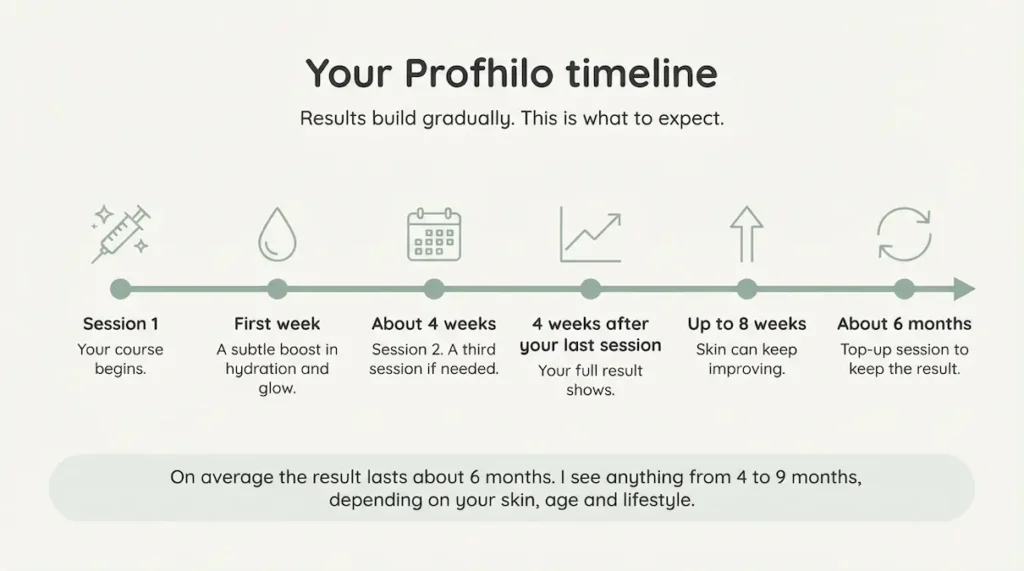
On average the result lasts about 6 months. In my patients I see anything from 4 to 9 months, depending on skin type, age, lifestyle and how well hydrated the skin is. That’s why I book the top-up at around 6 months.
I don’t show before-and-after photos for Profhilo. The change is mostly in how the skin feels and behaves, and photos don’t capture it well.
Looking after your skin between sessions
Profhilo works best alongside good skincare. Between sessions I usually recommend a retinol serum such as Demani Retinol Serum*, an antioxidant serum such as Rejuvenate Active Serum*, a night cream such as Recover Night Cream*, and a daily SPF 50.
How much Profhilo costs
Profhilo costs €350 a session for the face, €450 for the neck and €700 for the face and neck together. See the cosmetic injection price list for current prices.
Profhilo FAQs
How long does Profhilo last?
About 6 months on average after a full course. I see a range of 4 to 9 months, depending on your skin, age and lifestyle, so I usually book a top-up at around 6 months.
How many Profhilo sessions do I need?
Two sessions about 4 weeks apart for most people. I add a third for more advanced laxity or when treating the face and neck together.
When does Profhilo start to work?
You may see a little extra glow in the first week. The firming builds gradually, with the full result about 4 weeks after your last session.
Is Profhilo a filler?
No. It’s a hyaluronic acid injectable that spreads under the skin to hydrate and firm it. It doesn’t add volume or change your face shape.
Will Profhilo lift my jowls?
No. Profhilo can improve early softening along the jawline by firming the skin, but it doesn’t lift sagging jowls. For that, I’d talk to you about other options at your consultation.
Does Profhilo hurt?
Most people find it very manageable. You’ll feel a small scratch at each point and a little pressure as the gel spreads. I can use a numbing cream if you’d like.
What’s the difference between Profhilo and Sculptra?
Profhilo improves skin quality: hydration, firmness and texture. Sculptra is a collagen stimulator for deeper structural change and volume loss, built up over several months. My Sculptra and Radiesse guide explains it in more detail.
Can men have Profhilo?
Yes. The same rule applies: it suits skin that has become dull, dry or crepey, not significant sagging or volume loss.
References
- Cassuto D, Delledonne M, Zaccaria G, Illiano I, Giori AM, Bellia G. Safety assessment of high- and low-molecular-weight hyaluronans (Profhilo) as derived from worldwide postmarketing data. BioMed Research International. 2020;2020:8159047. Read the paper
*Demani Skincare is owned by a member of my family, and I helped develop the range.