Medically reviewed and updated by Dr Hazem Kahlout, November 2026
Most people who ask me about BabyGlow have seen the phrase “glass skin” and want it. They want skin that looks hydrated and rested, with softer fine lines, smoother texture and pores that look smaller. What they don’t want is a different-looking face. Many worry that any injection will add volume or leave them looking “done”.
BabyGlow is a good answer to that worry, as long as we’re clear about what it does. It improves the quality of the skin. It doesn’t add volume, lift or change your face shape. I carry out every BabyGlow treatment at the clinic in Castleknock, Dublin 15, myself.
| BabyGlow at a glance | |
|---|---|
| Product | Teosyal Redensity 1, made by Teoxane |
| What it improves | Hydration, glow, fine lines, texture and elasticity |
| What it doesn’t do | Add volume, lift or reshape the face |
| Course | 2 sessions (under 35) or 3 sessions (35 and over), 4 weeks apart |
| When you’ll notice it | Skin often looks brighter and more hydrated by about day 4 |
| Maintenance | About every 6 months |
| Downtime | Small bumps at the injection points that settle in about 48 hours |
| Cost | From €350 a session (price list) |
What BabyGlow is
BabyGlow is a treatment protocol designed by Teoxane, a Swiss company that makes hyaluronic acid injectables. It uses one product, Teosyal Redensity 1, placed at set points across the face so it spreads evenly under the skin.
Redensity 1 isn’t a dermal filler. Fillers are firmer gels made to hold a shape, such as in the lips or cheeks. Redensity 1 is a soft, fluid hyaluronic acid that isn’t cross-linked, so it hydrates the skin rather than building it up. Alongside the hyaluronic acid it contains amino acids, antioxidants, minerals and vitamin B6, and a local anaesthetic to make the injections more comfortable.
Teoxane has published early real-world results for the protocol. In a preliminary evaluation of nearly 80 women across several European countries, presented at a medical conference in Paris in January 2026, 98% said they saw an immediate glow and 98% felt they needed no downtime. That’s the manufacturer’s own data and not a controlled trial, but it matches what my patients tell me.
Who BabyGlow suits
When I examine people who ask for BabyGlow, I usually find dehydrated, dull skin, fine lines around the eyes and on the cheeks, rough texture, enlarged pores and uneven tone, often with some sun damage or redness. There may be a little laxity, but in the right person there’s very little volume loss.
That’s the skin BabyGlow is made for. It’s a good choice if your main concern is:
- skin that looks tired, dull or dehydrated even with a good skincare routine
- fine lines and rough texture
- pores that look larger than they used to
- a natural, “no make-up” finish without anyone guessing you’ve had something done
Some patients come in expecting a filler-like result. When that happens, I explain what BabyGlow can and can’t do before we go any further. If your main concern is lost volume, the liquid facelift with Softlift is the right treatment, not BabyGlow.
When I postpone or say no
I’ll ask you to wait, or suggest a different treatment, in these situations:
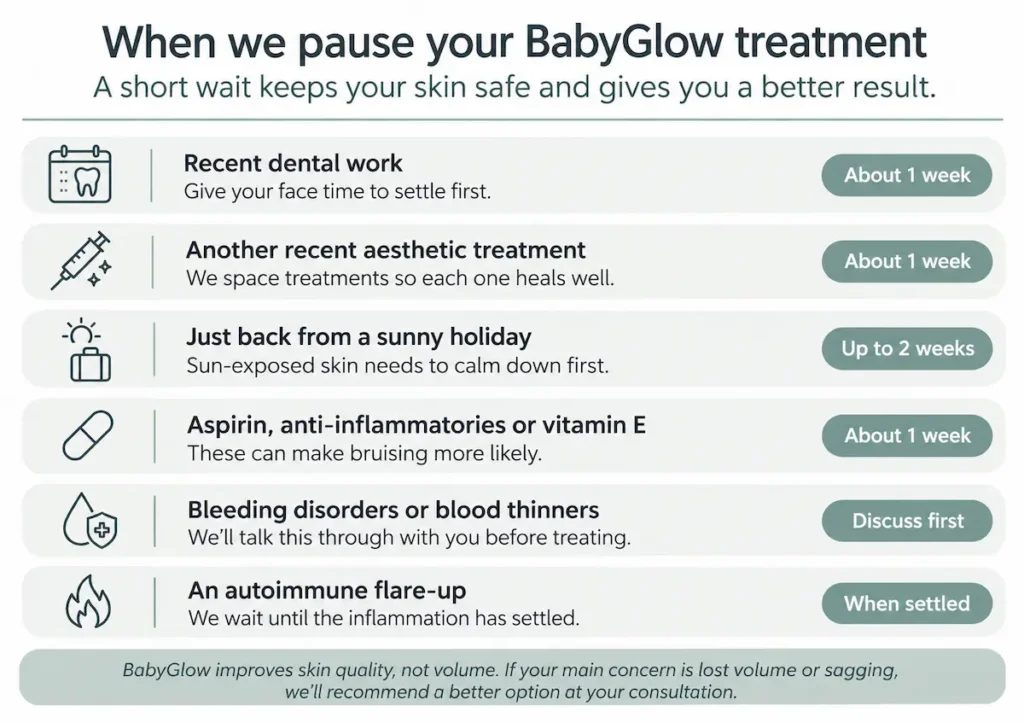
- dental work or another aesthetic treatment in the last week
- a sunny holiday in the last 2 weeks
- aspirin, anti-inflammatories or vitamin E in the last week, as these make bruising more likely
- a bleeding disorder or blood-thinning medication, which we’ll talk through before anything is booked
- an autoimmune flare-up, until the inflammation has settled
- expectations BabyGlow can’t meet, or a main concern of lost volume or significant sagging
Where BabyGlow is placed
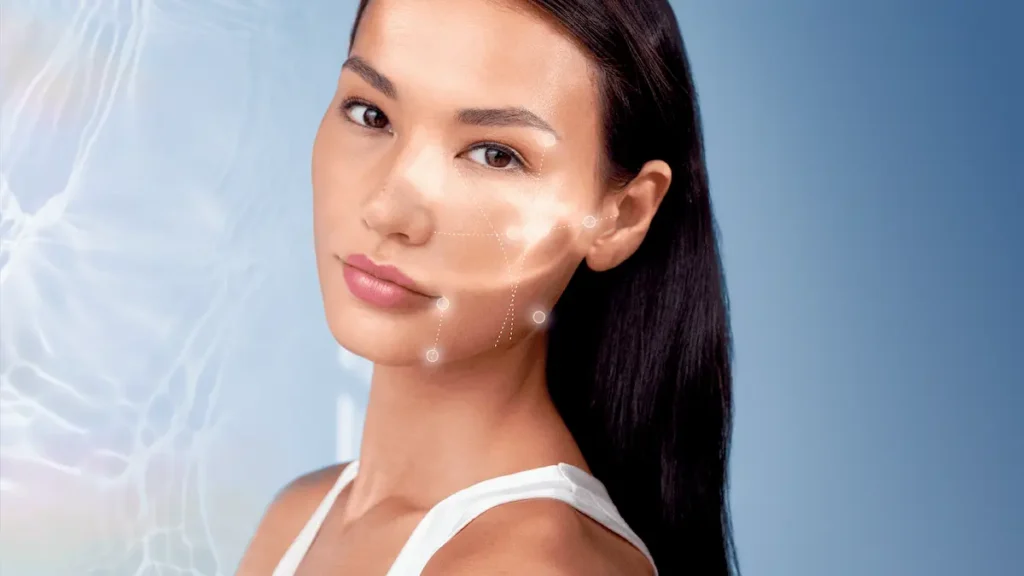
BabyGlow follows Teoxane’s set injection protocol. The treatment points sit around the tail of the brow, in front of the ear, along the cheekbone, in the mid-cheek, along the jawline and around the mouth and chin. From these points the product spreads under the skin across the face. I adjust the plan to your skin at your consultation.
How many BabyGlow sessions you need
I tailor the course to your age and your skin:
- Under 35: 2 sessions, 4 weeks apart. Teoxane calls this the beautification protocol.
- 35 and over: 3 sessions, 4 weeks apart. This is the rejuvenation protocol.
I also take your hydration, laxity and how your skin responds into account, and I don’t space sessions closer together than this. After the course, a maintenance session about every 6 months keeps the result going.
Adding a photofacial
At the clinic I offer an extra step that isn’t part of Teoxane’s protocol: a photofacial using broadband light (a type of IPL). BabyGlow works from within, hydrating the skin and supporting its quality. The photofacial works on the surface, targeting pigment, redness and texture that BabyGlow doesn’t directly treat. Used together, in my experience, they give a more complete result for people who have both.
I almost never do both on the same day. Heat from light treatments and a freshly injected skin booster don’t mix well: the heat can break down the hyaluronic acid and add to inflammation. My usual order is BabyGlow first, then the first photofacial at least 2 weeks later, ideally with about 2 weeks between each treatment after that.
BabyGlow vs Profhilo
I choose between them after examining your skin, not by the name of the product you came in asking for. The question is which problem leads.
| BabyGlow | Profhilo | |
|---|---|---|
| Best for | Dullness, dehydration, poor light reflection, surface texture | Laxity, crepey skin, loss of bounce |
| Underlying skin | Fairly good tone | Early laxity |
| How soon | Glow often visible within days | Builds over weeks as the skin remodels |
| Course | 2 or 3 sessions, 4 weeks apart | 2 or 3 sessions, about 4 weeks apart |
If you have both laxity and dehydration, I may plan the two treatments across the year. Budget, downtime and whether you’d rather have a quicker glow or a slower firming all come into it too. You can read more on my Profhilo page. If you’re not sure which skin booster suits you, my skin boosters guide compares all the options I offer.
On the day and afterwards
Small raised bumps appear at each injection point straight after treatment. They’re expected and flatten out in about 48 hours. Please leave them alone and avoid touching your face, so the product can spread by itself.
For the first 24 to 48 hours afterwards, avoid:
- rubbing or massaging your face
- heat, such as saunas, steam rooms and hot yoga
- alcohol
- exercise
Every patient goes home with my written aftercare sheet.

Risks and side effects
The most common reactions are bruising, temporary swelling, redness, tenderness and the small bumps at the injection points. These usually settle within about 48 hours.
Lumps that last longer than a week are less common, but they are reported. The rarest serious risk with any injection into the face is a blocked blood vessel (vascular occlusion). It’s rare, but I watch for the warning signs during and after every treatment so it can be treated straight away.
To keep the risks low, I inject slowly, at the right depth for this product, I never overfill and I use a strict sterile, no-touch technique.
How soon you’ll see results and how long they last
Patients often tell me their skin looks brighter and more hydrated by about day 4. The glow builds with each session. Firmness, texture and fine lines improve more gradually across the full course, so I treat the first session as the start of the result, not the finished outcome. With maintenance every 6 months, most people keep the improvement going.
I don’t show before-and-after photos for BabyGlow. The change is mostly in how your skin feels and moves, and photos don’t capture that well.
Looking after your skin between sessions
Good skincare at home is part of getting a lasting result. I often suggest a hyaluronic acid serum such as Demani Quench*, which hydrates the surface while BabyGlow works deeper, along with a daily SPF.
How much BabyGlow costs
BabyGlow costs €350 a session, and the optional photofacial costs €200 a session. See the cosmetic injection price list for current prices.
BabyGlow FAQs
How many sessions of BabyGlow do you need?
Two or three. I usually recommend 2 sessions 4 weeks apart if you’re under 35, and 3 sessions 4 weeks apart if you’re 35 or over, then maintenance about every 6 months.
How long does BabyGlow last?
The improvement from a full course usually lasts around 6 months, which is why I suggest a maintenance session at that point. It varies with your age, skin and lifestyle.
Where are the injection points for BabyGlow?
Around the tail of the brow, in front of the ear, along the cheekbone, in the mid-cheek, along the jawline and around the mouth and chin. The exact plan follows Teoxane’s protocol and is adjusted to your skin.
Is BabyGlow a filler?
No. It uses Teosyal Redensity 1, a soft hyaluronic acid skin booster that hydrates the skin. It doesn’t add volume or change your face shape.
Does BabyGlow hurt?
Most people feel a series of small pricks. The product contains a local anaesthetic, which makes the injections more comfortable.
Is there any downtime?
Very little. You’ll have small bumps at the injection points that settle in about 48 hours, and sometimes some redness or a bruise. In Teoxane’s evaluation, 98% of women felt they needed no downtime.
Can I have BabyGlow and IPL on the same day?
I don’t recommend it. Heat can break down the hyaluronic acid and add to inflammation, so I do BabyGlow first and the photofacial at least 2 weeks later.
Is BabyGlow worth it?
It is for the right skin: dull, dehydrated or rough-textured skin with good underlying tone. It isn’t worth it if what you really want is volume or a lift, and I’ll tell you so at your consultation.
References
Teoxane. babyGLOW real-world evidence. Teoxane newsroom, 25 January 2026. Based on Caboni S, Sezgin B, Criollo G, et al. E-poster, IMCAS World Congress, Paris, January 2026. Read on teoxane.com
*Demani Skincare is owned by a member of my family, and I helped develop the range.