Medically reviewed and updated by Dr Hazem Kahlout, November 2026
People who ask me about Sculptra rarely point to a single wrinkle. They tell me they look tired, their cheeks look flatter, their temples have hollowed or their jawline has softened. They want to look refreshed, not filled, and to look like the best version of themselves rather than a different face.
Sculptra can do that for the right face, but the one expectation I always reset is timing. It isn’t an instant filler. It encourages your skin to build its own collagen, so the change comes gradually over months, not on the day. I carry out every Sculptra treatment myself at the clinic in Castleknock, Dublin 15.
| Sculptra at a glance | |
|---|---|
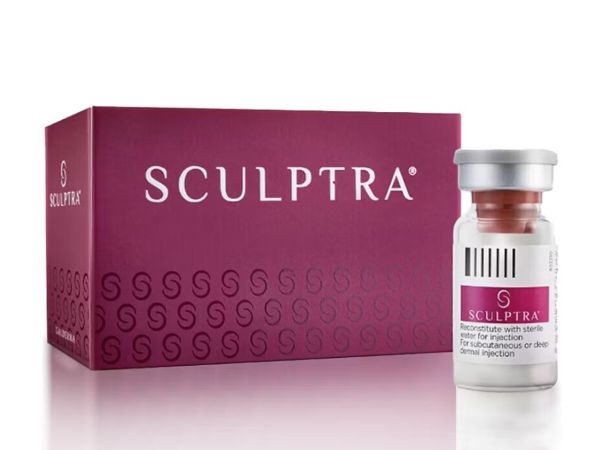
| What it is | Poly-L-lactic acid (PLLA), a collagen stimulator made by Galderma |
| What it improves | Broad volume loss in the temples, cheeks and jawline, and skin firmness |
| What it doesn’t do | Give an instant result, precise contouring or lift heavy sagging |
| Course | 2 to 4 sessions, 4 to 6 weeks apart, 1 or 2 vials each time |
| First changes | Usually 4 to 6 weeks after the first session |
| Full result | 6 to 12 months after the last session |
| How long it lasts | Usually 18 to 24 months, often longer |
| Cost | €500 a vial, or €900 for two vials in one session (price list) |
What Sculptra is
Sculptra is made of poly-L-lactic acid, the same material used in dissolving stitches. Once it’s in place, your body reacts to the tiny particles by laying down new collagen around them. Over the following months the particles break down and your own collagen stays.
That’s why Sculptra isn’t really a filler. Hyaluronic acid filler adds volume you can see straight away. Sculptra gives your skin and the tissue underneath more support of its own, so the improvement builds slowly and looks like you.
Who Sculptra suits
When I examine people who ask for Sculptra, I usually find volume loss spread across the face rather than one problem area: flatter cheekbones, hollow temples, a thinner midface and a softer jawline with early jowls. Many also have thinner skin that has lost its firmness and looks dull or crepey. They need support for the skin as well as volume.
The first thing I work out is whether your face has lost fullness or has dropped. I explain the difference in my sinkers and saggers article. Sculptra suits faces that have lost fullness. If loose skin or heavy jowls are the main problem, Sculptra alone will disappoint, and skin tightening or surgery may be the better route.
Sculptra is a good choice if:
- your face looks tired or deflated rather than lined
- the volume loss is spread across the temples, cheeks and jawline
- you want a gradual change that people won’t notice as treatment
- you’d like a longer-lasting result with less frequent top-ups than filler
It isn’t the right choice if you want an instant result or precise shaping of one area. For that, hyaluronic acid filler is usually better.
When I postpone or say no
Sculptra works by provoking a controlled reaction in your tissue, so your history matters. I won’t treat you with Sculptra if you have:
- a history of keloid or raised scars
- severe allergies, including anaphylaxis, or several severe allergies
- an allergy to local anaesthetic
I’ll ask you to wait, or suggest a different treatment, if you:
- have an active autoimmune condition or take medicines that suppress the immune system, as these can make lumps more likely
- have had a facelift or facial bone surgery in the area
- have had dental work or another aesthetic treatment in the last week
- have been on a sunny holiday in the last 2 weeks
- have taken aspirin, anti-inflammatories or vitamin E in the last week
- have a bleeding disorder or take blood-thinning medication, which we’ll talk through first
- are pregnant or breastfeeding
- want an instant result or precise contouring that Sculptra can’t give
I don’t use Sculptra in the thin, moving skin around the mouth or close to the eyes, where lumps are more likely.
How a course of Sculptra works
A course of Sculptra is cumulative collagen stimulation, not one-off filling. Most people need 2 to 4 sessions, about 4 to 6 weeks apart. That gap lets me see how your skin has responded before adding the next layer.
On the face I use 1 or 2 vials per session. How many vials you need overall depends on how much volume you’ve lost, and I’ll plan it with you at your consultation.
I often treat the temples, cheeks and jawline in the same session, but not always all at once. Usually the first session builds the deeper support in the temples and midface, and later sessions build the cheeks and jawline and refine the result.
On the day
The treatment takes 30 to 45 minutes. I make sure the area is properly numb before I start, and the Sculptra itself is mixed with local anaesthetic, which helps a lot.
You may look a little fuller straight afterwards. That’s the water the product is mixed with, and it settles within a few days. It isn’t the result.
Most people go back to work the next day. If you bruise, it can show for a few days, so I’d avoid booking Sculptra just before an important event.
Aftercare: the 5-5-5 rule
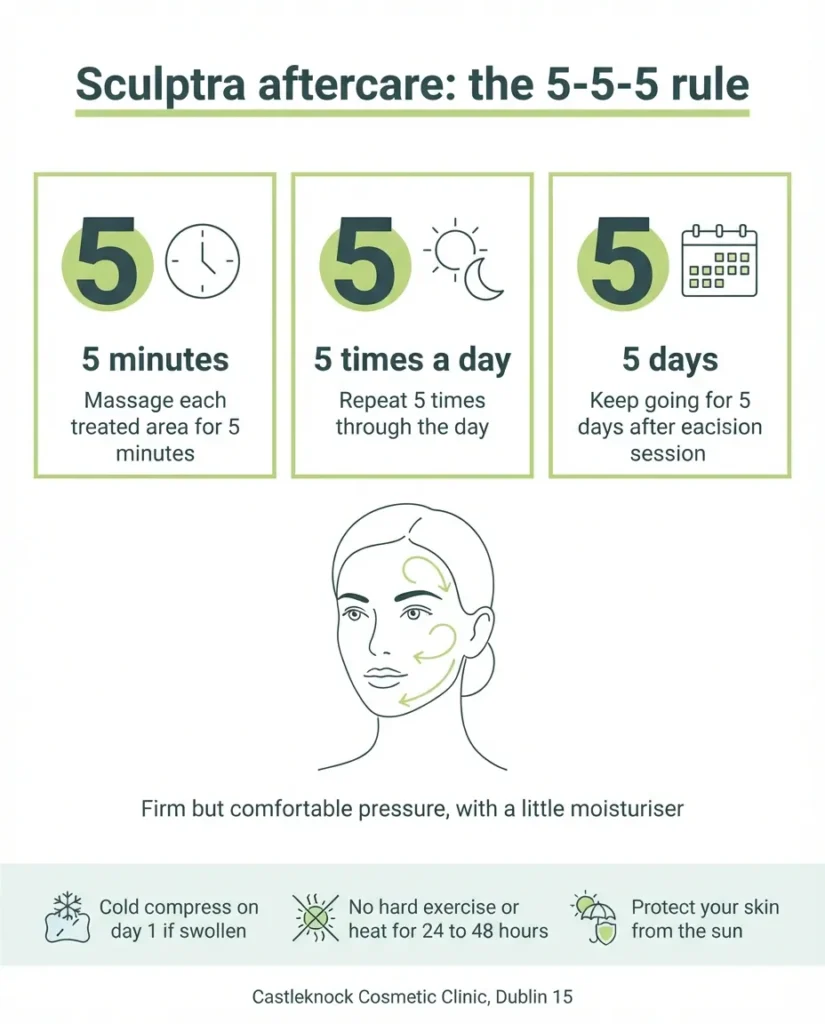
Massage matters with Sculptra. It helps the product settle evenly, and not massaging enough is a known cause of lumps. For 5 days after each session, massage the treated areas for 5 minutes, 5 times a day, with firm but comfortable pressure and a little moisturiser.
For the first 24 to 48 hours, also:
- use a cold compress for the first day if you’re swollen
- avoid strenuous exercise and heat, such as saunas, steam rooms and hot yoga
- protect your skin from the sun
Every patient goes home with my written aftercare sheet.
Risks and side effects
The most common reactions are redness, swelling, bruising and tenderness. They usually settle within a few days to a week. Occasionally a small collection of blood (a haematoma) forms under the skin, which also settles.
The side effect people ask about most is lumps, or nodules. Some appear in the first 3 to 6 weeks; others, which are rarer and more inflammatory, can appear months later. Most are small, can be felt but not seen, and settle on their own. A few need treatment. I reduce the risk through how I prepare and place the product, by not overtreating, and by asking you to follow the 5-5-5 rule.
The rarest serious risk with any injection into the face is a blocked blood vessel. I watch for the warning signs during and after every treatment so it can be treated straight away.
Sculptra can’t be dissolved the way hyaluronic acid filler can, which is another reason I take time at the consultation to make sure it’s right for you.
When you’ll see results and how long they last
The first changes are subtle: slightly firmer skin or a gentle lift, usually 4 to 6 weeks after your first session. Some people don’t notice anything until 8 to 12 weeks.
The final result comes well after the course ends. Collagen keeps building for 6 to 12 months after the last session, and in some people it keeps refining for up to 18 months.
A published report based on more than 2,500 patients found that the correction lasted 18 to 24 months in most. In my experience, many patients keep a good result for around three years. Your skin quality, age, sun exposure and lifestyle all make a difference.
I review you at 12 months. If your result is stable, a top-up may not be needed until about 18 months. If it’s softening sooner, I’ll see you sooner. A top-up is usually one vial, occasionally two. The aim is to keep the collagen scaffold going, not to repeat the whole course.
Sculptra before and after
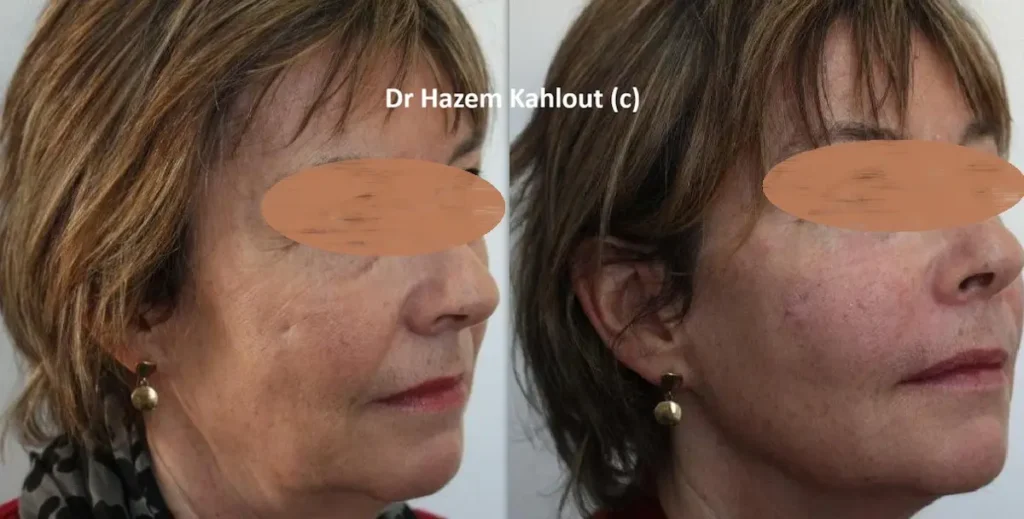
8 vials over 4 sessions. “After” photo taken 6 months after the last session. Individual results vary.
Because Sculptra changes the whole face gradually, it’s hard to show without showing the person, so I only publish results where the patient has agreed, and I’ve cropped this one to protect their privacy.
Sculptra or something else?
I choose the treatment after examining you, not by the name of the product you ask for.
- Hyaluronic acid filler gives immediate, precise volume that can be dissolved, and usually lasts 6 to 18 months. I use it for focused correction you want straight away. Sculptra suits widespread volume loss when you’re happy with a slower result.
- Profhilo improves skin quality: hydration, crepiness and early laxity. If your skin looks dull and crepey, Profhilo is usually the better start. If your face looks flat or deflated, Sculptra is.
- Fat transfer uses your own fat to restore volume in a single procedure, and nanofat is used for fine lines and skin tone. If you might want fat transfer in future, I’d avoid Sculptra beforehand, because it can leave scar tissue that makes it harder for the fat to survive.
- Radiesse is another collagen stimulator that also gives some immediate support. My Sculptra vs Radiesse guide compares the two.
How much Sculptra costs
Sculptra costs €500 for one vial, or €900 for two vials in the same session. The number of vials and sessions is tailored to your face, and I’ll confirm your plan and cost at your consultation. See the cosmetic injection price list for current prices.
Sculptra FAQs
Is Sculptra a filler?
Not in the usual sense. Hyaluronic acid filler adds volume straight away. Sculptra stimulates your skin to make its own collagen, so the result builds gradually over months.
How much does Sculptra cost in Ireland?
At my clinic, Sculptra costs €500 for one vial, or €900 for two in one session. The total depends on how many vials and sessions your face needs.
How long does Sculptra last?
Usually 18 to 24 months, and in my experience often around three years. I review you at 12 months and suggest a top-up when you need one.
How many sessions of Sculptra do I need?
Most people need 2 to 4 sessions, 4 to 6 weeks apart, with 1 or 2 vials each time.
When will I see results from Sculptra?
Subtle changes usually show 4 to 6 weeks after the first session. The full result develops over 6 to 12 months after the last one.
What is the downside of Sculptra?
You have to wait for the result, it can’t be dissolved, and you need to massage the area for 5 days after each session. Small lumps can occur, though most settle on their own.
Is Sculptra better than filler?
Neither is better; they do different jobs. Filler gives instant, precise volume in one area. Sculptra rebuilds broad support gradually and lasts longer.
Is Sculptra better than anti-wrinkle injections?
They treat different things. Anti-wrinkle injections relax the muscles that cause expression lines. Sculptra restores lost volume and firmness. Many people benefit from both, and my fillers and anti-wrinkle injections comparison explains more.
Can Sculptra be used under the eyes?
I don’t inject Sculptra close to the eyes, because the skin there is thin and lumps are more likely. My under-eye treatment guide covers the options I use instead.
Is Sculptra worth it?
For the right face, yes: someone with broad volume loss who wants a natural, longer-lasting result and is happy to wait for it. If you want an instant change or have mainly loose skin, I’ll tell you at your consultation and suggest something that suits you better.
References
- Vleggaar D. Facial volumetric correction with injectable poly-L-lactic acid. Dermatologic Surgery. 2005;31(11 Pt 2):1511–1517. Read the abstract