Medically reviewed and updated by Dr Hazem Kahlout, November 2026
People keep asking if you’re tired, even when you’ve slept well. Concealer helps for an hour, then the shadow under your eyes is back. For many people, the cause isn’t tiredness at all. It’s the groove between the lower eyelid and the cheek, called the tear trough, and the shadow it casts.
Tear trough filler, often called under-eye filler, softens that groove so the area catches the light again. I’ve been treating tear troughs at Castleknock Cosmetic Clinic for more than 20 years, and patients travel to us from as far as Galway, Limerick and Cork. It’s one of the most delicate areas of the face to treat, so here’s how I decide who it suits and how I do it.
What tear trough filler can do
The tear trough is the groove that runs from the inner corner of the eye down towards the cheek. When we’re young, the lower lid blends smoothly into the cheek. With age, the bone and fat that support the area recede, and a line forms where the two meet. Some people have deep tear trough lines from their twenties because of the way their face is built.
Dermal filler placed carefully along that line restores the support that’s been lost. The groove softens, the shadow fades, and the eyes look more rested. Filler can’t remove eye bags, tighten loose skin or lighten brown pigment, which is why the assessment matters so much.
Google Review
Kim S. ★★★★★
“I would never go anywhere else other than Castleknock Cosmetic Clinic for my facial procedures. I trust Dr. Kahlout completely. He always was up front and honest about exactly what I needed and delivered just that ! Himself, Maggie and the team are so professional with such a personable touch, which is so important, especially when having any kind of Cosmetic treatments to the face.
There is no other Clinic I would recommend.
Thank you so much Dr Kahlout
Kim”

Is tear trough filler right for you?
The ideal candidate has firm skin over a mild to moderate tear trough. If that sounds like you, filler can work very well.
It isn’t the right treatment for everyone. If you have true eye bags, where the fat under the eye has pushed forward, filler can make the area look heavier. The same goes for loose, heavy folds of skin below the eye (festoons) or very crepey skin. For these, lower eyelid surgery (blepharoplasty) usually gives a better result, and I’ll refer you to a surgeon in Ireland who performs it.
If the cheek below the eye has sunk, treating the tear trough alone can leave the area looking unbalanced. In that case I support the cheek too, with cheek filler or SoftLift, either at the same appointment or as a first stage.
If the skin under your eyes is very thin, filler may show through it. Your own fat can be a better choice, which I cover below.
How I assess your under-eyes
I don’t look at the groove on its own. I look at your face as a whole, and then at each layer under the eye:
- the bone structure around the eye socket and cheek
- the fat pad that sits beneath the muscle under the eye, its position and what state it’s in
- the line where the lower lid meets the cheek, and the skin above and below it
- the colour of the skin and how see-through it is
- how elastic the skin is, using a lid flick test: I gently draw the lower lid down and watch how quickly it springs back
- how many blood vessels show through the skin
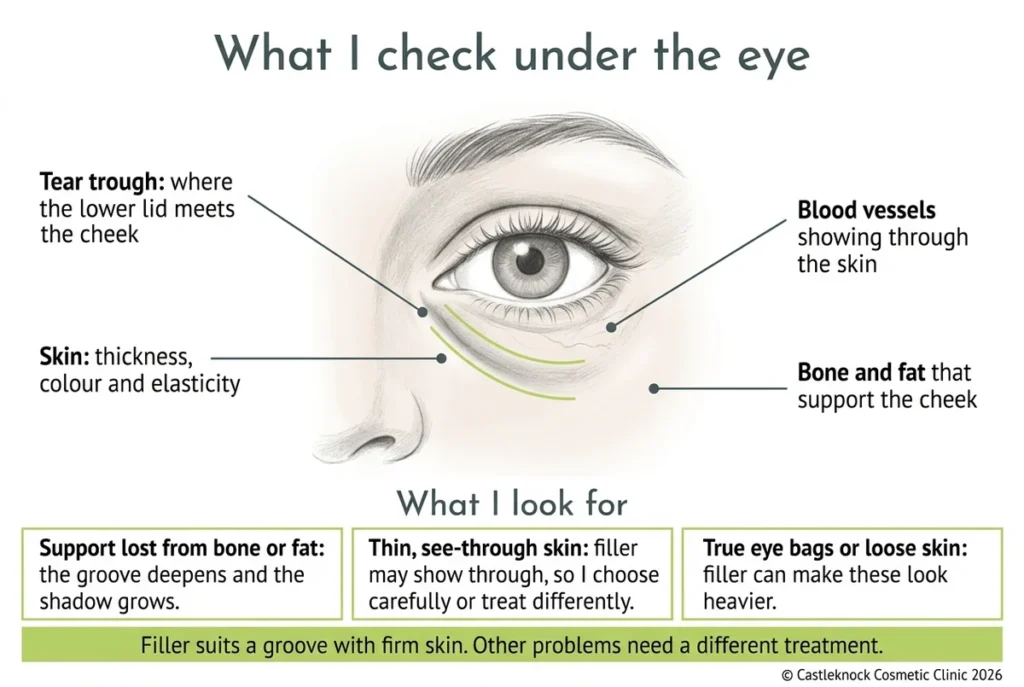
Those findings decide the plan. If the support underneath has been lost, I start deeper with a firmer filler. If the skin itself is thin and see-through, only a very soft filler goes near the surface, and sometimes none at all. If the skin is slow to spring back or the area is very vascular, filler may not be the right treatment, and I’ll explain the alternatives.
Choosing the right filler for tear troughs
There isn’t one best filler. The right choice depends on what I find at your assessment, and many people need two types.
For deeper support, I use firmer fillers such as Restylane Refyne or Juvéderm Ultra. For the delicate skin of the lower lid, I use much softer fillers with less lift, such as Juvéderm Volbella, Belotero Soft or Restylane Skinbooster. Many patients need a combination: a firmer filler deep down to rebuild support, and a softer one closer to the surface to smooth the transition.
Your appointment
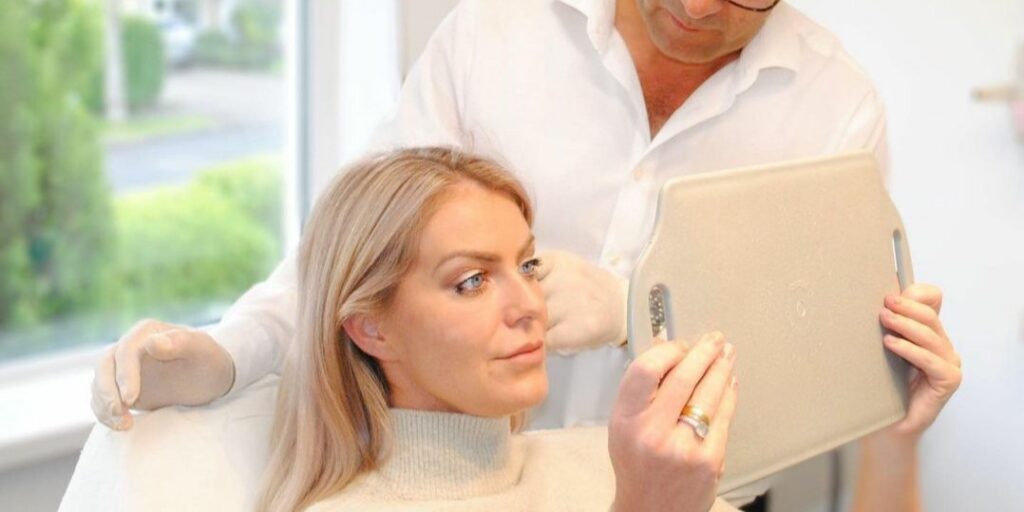
A straightforward tear trough appointment takes about 30 minutes. If I’m using fillers of different firmness, or treating the cheek at the same time, I allow an hour.
For numbing I use a nerve block, which numbs the area so the treatment is as comfortable as possible. I place the filler with a blunt cannula rather than a sharp needle. It’s gentler on the tissue, it separates the layers so the filler goes exactly where it should, and it makes bruising less likely.
Swelling and bruising
Some swelling is expected after tear trough filler, and some people swell more than others. I’ll tell you what to expect before we start.
Bruising is common after filler, and the lower eyelids are one of the places it shows most often. It usually settles within 5 to 10 days. A blunt cannula is linked to less swelling and bruising than a needle. I explain more in my post on why injectable treatments don’t have to be bruising. Preparation helps: a calm setting, the cannula, and a cool pack on the skin before I inject if needed.
Tear trough filler migration and puffiness
Filler under the eyes is more likely to move than filler elsewhere. The eyes move all day, and the tissue where the lid meets the cheek is delicate. Choosing the right filler and placing it at the right depth makes migration much less likely, but it can still happen.
Sometimes filler shows as a bluish tint under the skin, known as the Tyndall effect. It happens when too much filler is used, or when the skin was too thin for filler to be the right choice. It happens when too much filler is used, or when the skin was too thin for filler to have been the right choice. If it happens, the right approach is to dissolve the filler and reassess. Hyaluronic acid filler can be dissolved with an enzyme. My post on filler migration explains more about why filler moves and how it’s corrected.
How long does tear trough filler last?
Longer than most people expect. In my experience, most patients benefit for more than a year at a time, and sometimes even longer.
That matches what MRI scans are showing. In a 2024 review of 33 patients, scans found hyaluronic acid filler in the mid-face of every patient at least two years after their last treatment, and in some much longer. Nine had been scanned because of swelling concerns. Filler showing on a scan doesn’t mean the cosmetic effect lasts that long, and the study looked at the mid-face rather than the tear trough.
Because filler under the eyes can stay for years, getting it right the first time matters. Too much filler, or the wrong filler, doesn’t simply wear off in six months. That’s why I take time over the assessment and use less rather than more.
Nano fat: an alternative for thin skin
If the skin under your eyes is thinning but the groove is mild to moderate, your own fat can work better than filler. I take a small amount of fat from the knees, flanks or belly under local anaesthetic. It’s then processed with the Tulip system, which separates it into micro fat and nano fat so each can be placed at the right depth.
Fat lasts much longer than filler. It matures with you, and most people don’t need to consider further treatment for three to five years. You can read more on my Nano Fat page.
Aftercare
For the first day or two:
- use cool packs for the first 24 hours
- don’t rub your eyes or massage the area
- avoid saunas, hot baths and sunbeds
- sleep propped up for a night or two
Your review
I review you at about a month. By then any swelling or bruising has settled, and I can check that the filler has stayed where it should. If a small touch-up is needed, it’s usually included in the original price.

Tear trough filler prices in Dublin
Tear trough filler at Castleknock Cosmetic Clinic starts from €600. The final cost depends on the fillers and the amount you need, which I’ll confirm at your consultation. You’ll find the full list, including nano fat, on our cosmetic injection price list.
Tear trough filler FAQs
Is under-eye filler the same as tear trough filler?
Yes. Both names describe filler placed in the groove between the lower eyelid and the cheek.
Does tear trough filler hurt?
I use a nerve block to numb the area, so most people find it very manageable.
Will tear trough filler get rid of my eye bags?
No. Filler can make true eye bags look heavier. Bags usually respond better to eyelid surgery, and I can refer you to a surgeon.
Can tear trough filler help dark circles?
It helps when the dark circle is a shadow cast by the groove. It doesn’t lighten brown pigment or visible blood vessels. My guide to under-eye treatments explains the different causes of dark circles and what helps each one.
When will I see the result?
You’ll see a difference straight away. The final result shows at around two weeks, once the swelling has gone.
Can tear trough filler be dissolved?
Yes. Hyaluronic acid filler can be dissolved with an enzyme if it’s in the wrong place or you’re unhappy with it.
How often will I need a top-up?
In my experience, more than a year for most people, and often longer.
If you’d like to know whether tear trough filler could help you, book a consultation at our clinic in Castleknock, Dublin 15. I’ll assess your under-eyes properly and tell you honestly whether filler, your own fat or surgery is the better option.
References
- Master M, Azizeddin A, Master V. Hyaluronic acid filler longevity in the mid-face: a review of 33 magnetic resonance imaging studies. Plast Reconstr Surg Glob Open. 2024;12(7):e5934. https://pmc.ncbi.nlm.nih.gov/articles/PMC11250456/
- Mehta P, Li J, Woodward J, Zhang-Nunes S. Non-ischemic complications of dermal fillers. Plast Aesthet Res. 2023;10:41. https://www.oaepublish.com/articles/2347-9264.2022.28


