Medically reviewed and updated by Dr Hazem Kahlout, November 2026
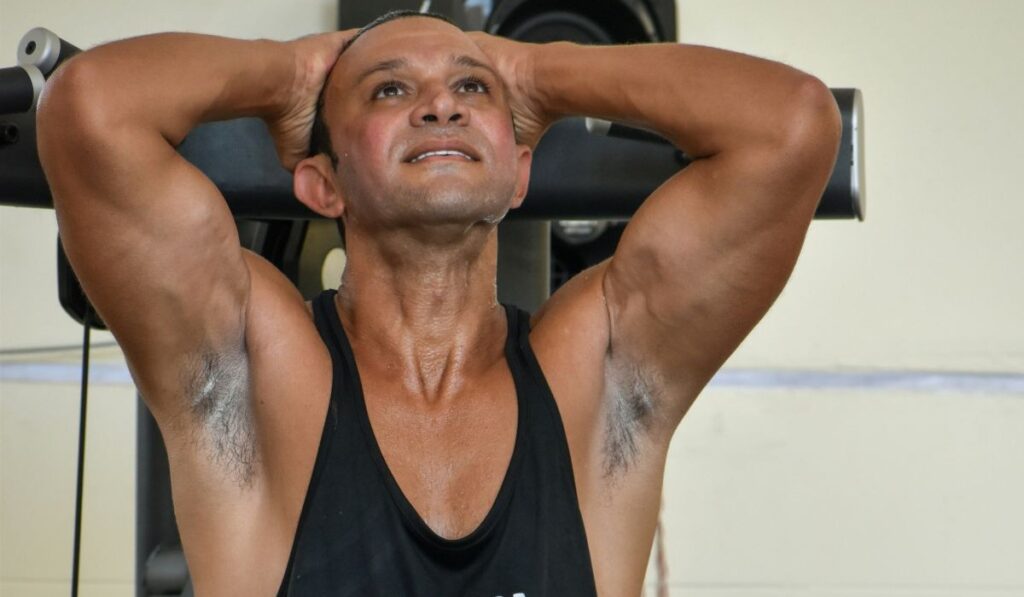
You plan your clothes around sweat marks. You avoid shaking hands, raising your arms or holding someone’s hand. Paper wrinkles under your fingers, and your phone slips out of your grip. By the time most people come to see me about excessive sweating, they’ve tried every antiperspirant in the chemist and they’re tired of hiding it.
Excessive sweating has a medical name, hyperhidrosis, and it can be treated. Here’s how I work out what’s causing yours, and how I treat the underarms, hands, feet and forehead.
Hyperhidrosis treatment at a glance
| What it treats | Excessive sweating of the underarms, hands, feet and forehead |
| First step | A consultation to check whether there’s an underlying cause |
| Underarms and forehead | Usually treated on the day of your consultation, in about 30 minutes |
| Hands and feet | Booked as a separate, longer appointment, with numbing |
| Results last | Usually 4 to 7 months for the underarms, hands and feet, and often 6 to 9 months under the arms. About 3 to 4 months for the forehead |
| Review | Included, with a top-up if a patch has been missed |
| Who treats you | Dr Hazem Kahlout |
| Tax relief | Treatment for hyperhidrosis may qualify for tax relief on health expenses |
What is hyperhidrosis?
We all sweat to keep cool. In hyperhidrosis, the nerves that control the sweat glands are overactive, so you sweat far more than your body needs, often when you’re not hot and haven’t been exercising.
There are two kinds. Primary hyperhidrosis has no underlying cause. It usually starts in childhood or the teenage years, often runs in families, and affects areas packed with sweat glands: the underarms, palms, soles of the feet and face. Secondary hyperhidrosis is caused by something else, such as menopause, an overactive thyroid, diabetes, an infection or a medication. Telling the two apart is the first thing I do, because secondary sweating needs its cause treated.

Is it hyperhidrosis, or a sign of something else?
The pattern of your sweating gives the strongest clues: where it happens, when, and since when.
Primary hyperhidrosis usually affects both sides evenly, stops while you sleep, and is set off by stress or emotion as much as by heat. Sweating that is more likely to have another cause tends to:
- start in adulthood, sometimes suddenly
- affect most of the body, rather than a few areas
- affect one side only, or come in patches
- happen at night, sometimes drenching the sheets
- come with other symptoms, such as fever, weight loss or a racing heart
Doctors use a simple checklist to recognise primary hyperhidrosis. If you’ve had excessive sweating for at least six months, with no obvious cause, and four or more of these apply to you, it’s very likely to be primary hyperhidrosis:
- It mainly affects your underarms, palms, soles or face.
- It affects both sides about equally.
- It doesn’t happen while you’re asleep.
- It happens at least once a week.
- It started before you were 25.
- Someone else in your family has it.
- It gets in the way of your daily life.
In research, this checklist identified primary hyperhidrosis correctly in about 99 out of 100 people.
At your consultation, I go through the pattern of your sweating, when it began, your family history, your medications and any other symptoms, and I examine you, including your thyroid. There’s no single blood test for hyperhidrosis. If anything suggests another cause, such as thyroid disease, diabetes, infection or menopause, I’ll ask your GP to arrange the right tests before we go any further.
How severe is your sweating?
Doctors often grade hyperhidrosis on a four-point scale, based on how much it affects your life:
- My sweating is never noticeable and never interferes with my daily activities.
- It’s tolerable, but sometimes interferes with my daily activities.
- It’s barely tolerable and frequently interferes with my daily activities.
- It’s intolerable and always interferes with my daily activities.
Most people who come to see me score 3 or 4.
What you’ve probably tried already
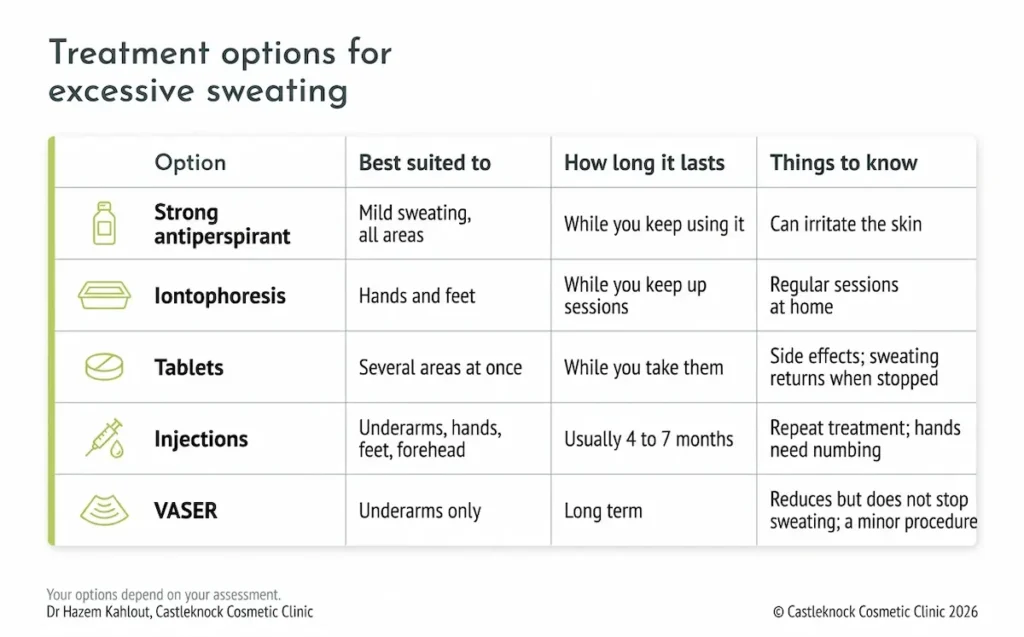
Most people I see have already tried the usual options without enough success. In my experience, the best approach is a combination built around you, rather than one single “best” treatment.
- A strong aluminium chloride antiperspirant is the starting point for almost everyone.
- Iontophoresis, a device that passes a mild current through water, works well for the hands and feet, but it means regular sessions at home, which many people find hard to keep up.
- Tablets that reduce sweating can help several areas at once, but their side effects put most people off taking them long term, and the sweating returns when you stop.
- A tablet taken before a stressful event can help some people, though many don’t like how it lowers their blood pressure.
When these haven’t worked, or you’d rather not take tablets every day, injections are the treatment I use most.
How the injections work
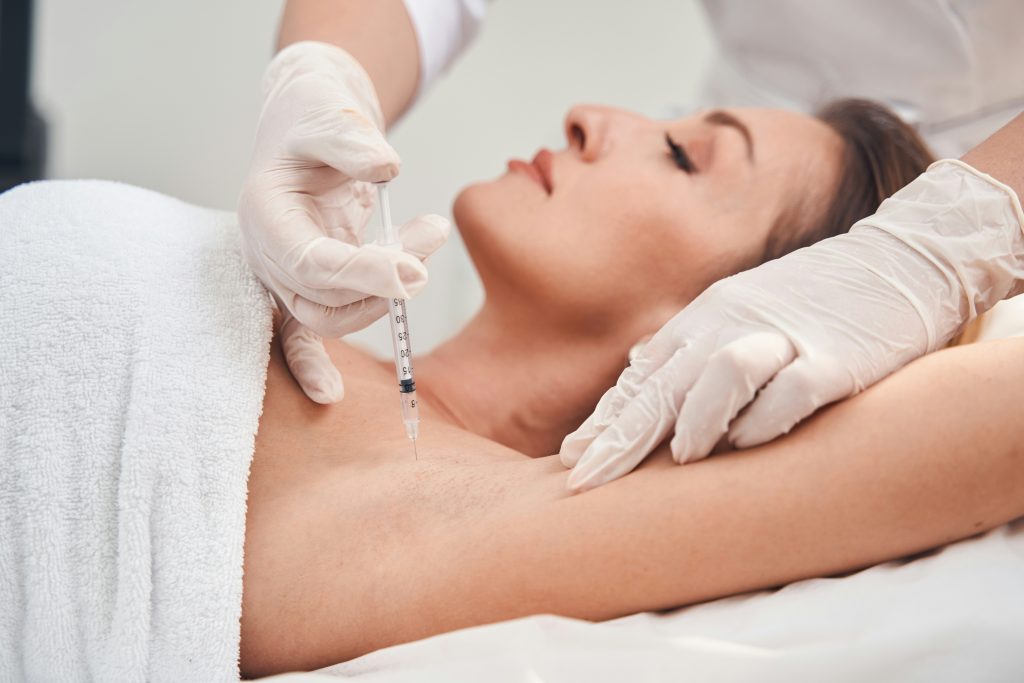
The same prescription-only medicine used in anti-wrinkle injections blocks the nerve signals that switch the sweat glands on. Placed in tiny amounts in the skin of the affected area, it greatly reduces sweating there for several months. It doesn’t affect sweating elsewhere, and your body can still keep itself cool.
Before treating, I map the area with a starch and iodine test. The sweating patches turn dark, so I can see exactly where to treat and where to leave alone.
Underarm sweating
The underarms are the most common area I treat, and where the results last longest.
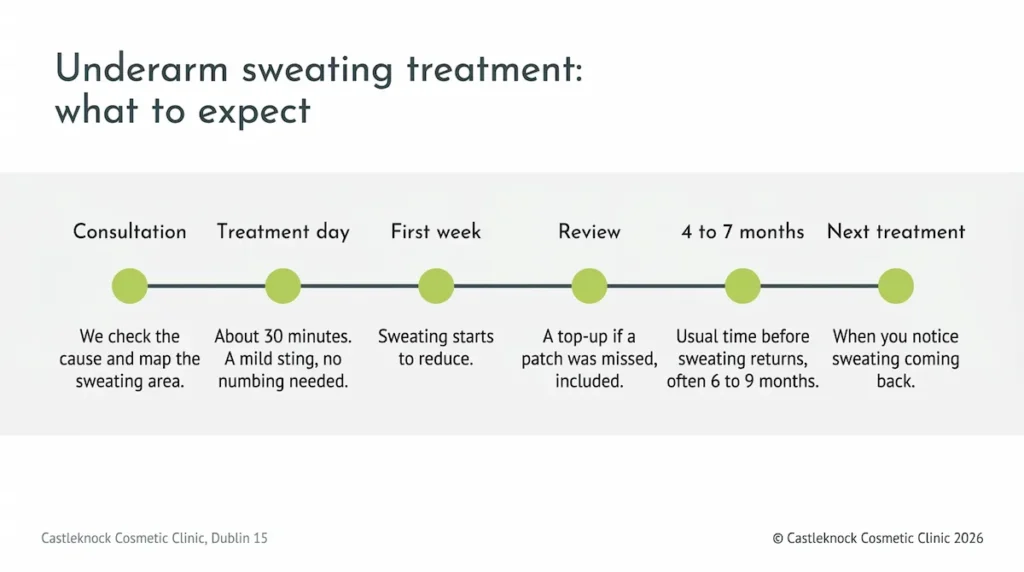
Treatment usually happens on the day of your consultation and takes about 30 minutes. The injections give a mild stinging feeling, which most people manage without any numbing. You may have a little tenderness or a small bruise afterwards, but nothing more.
The result usually lasts four to seven months, and many people stay dry for six to nine months.
Hand and foot sweating
The palms and soles are much more sensitive, so treating them is a different experience, and I book it as a separate, longer appointment.
Numbing creams only reach the surface of the skin, which isn’t enough for the palms, fingers, soles and toes. For most people, I offer a nerve block: an injection of local anaesthetic near the nerves that supply the hand, or the foot below the ankle. It’s a small procedure in its own right, and I’ll explain it fully beforehand.
After treatment of the hands, your fingers can feel slightly weaker or less nimble for a while. This is temporary, but it matters if your work depends on fine hand movements, and we’ll talk it through before you decide.
Results on the hands and feet usually last four to seven months.
Forehead sweating
The skin of the forehead is bound to the muscle underneath it, so it isn’t possible to treat forehead sweating without also relaxing that muscle. In practice, treating forehead sweating also softens forehead lines and changes how your forehead moves. Because of this, the result lasts more like an anti-wrinkle treatment, usually three to four months.
Treatment usually happens on the day of your consultation and feels much like treatment of the underarms.
How long results last
| Area | Usually lasts |
|---|---|
| Underarms | 4 to 7 months, often 6 to 9 months |
| Hands | 4 to 7 months |
| Feet | 4 to 7 months |
| Forehead | 3 to 4 months |
Most people come back when they notice the sweating starting to return.
VASER for underarm sweating
I also offer VASER, which uses ultrasound energy under local anaesthetic to remove some of the sweat glands under the arms. It reduces sweating for the long term, but it doesn’t stop it completely, and it has more side effects than injections for the improvement it gives. I keep it for the rare person whose sweating doesn’t respond to injections, or for someone who wants a lasting reduction instead of repeat treatments. For most people, injections give the better result.
Side effects and who shouldn’t have treatment
The common side effects are small: stinging during treatment, and tenderness or a small bruise at the injection points. Treatment of the hands can make the fingers feel weaker for a while, and treatment of the forehead changes how it moves.
Injections aren’t suitable if you’re pregnant or breastfeeding, or if you have certain conditions affecting the nerves or muscles. I’ll check your medical history at your consultation.
Your appointment
Your first visit is a consultation, where I check whether your sweating is primary or has another cause. If the underarms or forehead are being treated and you’re suitable, I usually treat you the same day. Treatment of the hands and feet is booked for a later appointment.
I see you again for a review, and if a patch has been missed, I top it up then. That’s included in your treatment.
Cost and tax relief
The cost depends on which areas need treatment, so I’ll confirm it at your consultation. Your review, and a top-up if needed, are included. You’ll find our current prices on the cosmetic injection price list.
Because hyperhidrosis is a medical condition, treatment may qualify for tax relief on health expenses. Keep your receipt, which records that the treatment was for hyperhidrosis.
Hyperhidrosis FAQs
What is excessive sweating a sign of?
Most often, it’s primary hyperhidrosis, which has no underlying cause and usually starts young. Sweating that starts suddenly in adulthood, affects your whole body, happens at night or comes with other symptoms can be a sign of something else, such as menopause, thyroid disease, diabetes, an infection or a medication. See your GP if that sounds like you.
Can hyperhidrosis be cured?
Primary hyperhidrosis can’t be cured, but it can be controlled very well. Injections greatly reduce sweating for several months at a time.
How long does hyperhidrosis treatment last?
Usually four to seven months for the underarms, hands and feet, and often six to nine months under the arms. Forehead treatment lasts about three to four months.
Does the treatment hurt?
Under the arms and on the forehead, most people feel a mild sting and need no numbing. The palms and soles are more sensitive, so I numb them with a nerve block.
Can sweaty hands and feet be treated?
Yes. They’re treated at a separate appointment with numbing. Your fingers may feel slightly weaker for a while afterwards.
Will I still sweat normally elsewhere?
Yes. Treatment only reduces sweating in the treated area, and the rest of your body still sweats to keep you cool.
Is the treatment the same as anti-wrinkle injections?
It uses the same prescription-only medicine, but it’s placed in the skin to calm the sweat glands, not in the muscles. Only the forehead treatment does both.
Can I claim tax relief?
Treatment for hyperhidrosis may qualify for tax relief on health expenses, because it’s a medical condition. Keep your receipt for your claim.
If sweating is getting in the way of your life, book a consultation at our clinic in Castleknock, Dublin 15. I’ll check what’s causing it and tell you honestly which treatment will help.