Medically reviewed and updated by Dr Hazem Kahlout, November 2026
Most people notice their chin in a side-on photo. The face looks fine from the front, but in profile the chin seems to slip back towards the neck, the nose looks bigger than it is, and the jawline loses its edge. It’s often the one feature that makes the rest of the face look out of balance.
Chin filler, also called non-surgical chin augmentation, brings the chin forward and gives it shape without an operation. I carry out every chin treatment at Castlekno/dermal-fillers/chin-augmentation/ck Cosmetic Clinic myself, and patients travel to us from across Dublin and from as far as Cork, Galway and Limerick. Here’s how I decide what your chin needs and how I treat it.
What chin filler can do
Filler placed carefully over the chin bone can:
- bring a weak or receding chin forward
- make a narrow chin wider and stronger
- lengthen a short chin slightly
- even out small differences between the two sides
Because the chin anchors the lower face, a small change there often changes how other features look. A stronger chin can make the nose look smaller, sharpen the jawline and make a double chin less noticeable, even though none of those areas has been treated.
How I assess your chin
Good chin filler starts with measurement, not with the syringe. I take side-profile photos and use two lines to judge how far forward your chin should sit.
The first, and my favourite, is based on the Frankfort horizontal. That’s a line running from the top of the ear canal to the lowest point of the eye socket. From it I draw a vertical line down through the front of the face, and the chin’s position against that line tells me whether it sits back, in balance or forward. The second is the Gonzalez-Ulloa line, which runs straight down from the bridge of the nose. I use whichever suits your face better.
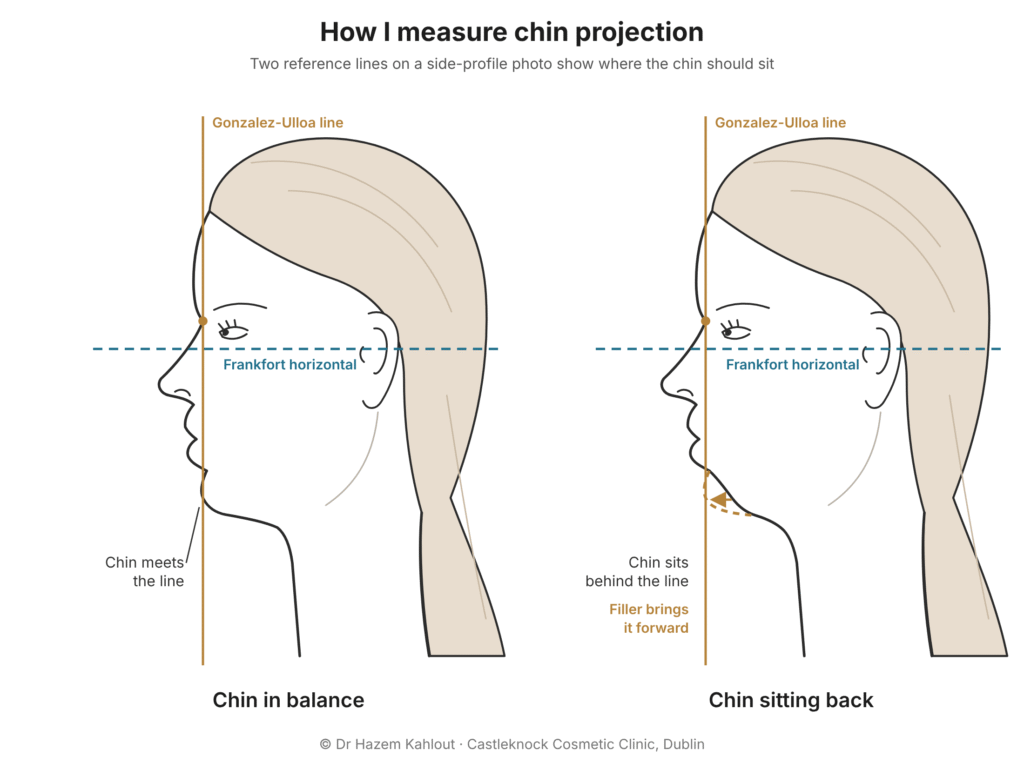
I also look at your bite, the length of your lower jaw and how your chin relates to your nose and lips. Men and women don’t need the same result. For a man, the chin usually looks best close to the vertical line. A woman’s chin can sit a little behind it and still look balanced and feminine.
If someone is unsure about the change, a saline test is possible. Salt water is injected where the filler would go, so you can see the effect before committing. It only lasts a few minutes before the body absorbs it, though, and with careful measurement I rarely find it necessary.
When filler isn’t the answer
Sometimes the problem isn’t the chin but the jaw. If your lower jaw is too short, giving an overbite, or the bite itself is out of line, filler can’t correct it and may make the face look odd. In that case the right step is a bone operation, such as a sliding genioplasty or jaw surgery, and I’ll refer you to an oral and maxillofacial surgeon.
If your measurements fall within the range filler can treat, it works very well. In my experience, with careful assessment and planning, the great majority of patients are happy with the result.
Chin filler or a chin implant?
A surgical chin implant is a solid silicone shape placed over the bone through a cut under the chin or inside the mouth. Some people need one, and for them surgery is the right choice.
Many of the patients I’ve seen with silicone implants are unhappy with how the chin feels to the touch, or feel it looks artificial. That’s why, where it suits the face, I prefer what I call a liquid implant. This is a firm, longer-lasting filler such as Ellansé, which I can shape to your chin rather than fitting a ready-made one, and which needs no operation.
Choosing the right filler
The filler I use depends on how much change you need and how sure we both are about the result.
For a first treatment or a smaller change, I usually start with a firm hyaluronic acid filler such as Restylane Defyne or Restylane Lyft. These are excellent for refining the chin, and if the result isn’t what you hoped for, they can be dissolved.
For a larger change, I prefer Radiesse or Ellansé. They’re firmer, hold their shape well and stimulate your own collagen. In my experience they’re also much less likely to move than hyaluronic acid filler, which matters in the chin. They can’t be dissolved, so I only use them once we’re confident about the result.
Whatever the filler, where it goes matters as much as which one. I place it either directly over the chin bone or within the chin muscle, depending on what we’re trying to achieve.
Chin filler for men
A “strong chin” has long been seen as a masculine feature, and many of the men I treat want exactly that: a chin that’s wider and squarer, not just longer. Getting that shape is mostly about where the filler is placed rather than how much is used, although men do tend to need a little more than women.
Men often combine chin filler with jawline filler to create a straighter, more defined line from the chin to the angle of the jaw. The aim is a result that looks like good bone structure, not like filler.
Balancing your whole profile
I rarely look at the chin on its own. The goal is a profile where each feature sits in proportion with the others, so chin filler is often part of a wider plan:
- jawline filler, to continue the line from the chin back towards the ear
- neck Liposuction and nose reshaping to balance the profile from both ends
- double chin treatment, such as neck liposuction or fat-dissolving injections, since a weak chin makes a double chin look worse
- anti-wrinkle injections for a dimpled or “orange peel” chin, caused by an overactive chin muscle
- Chin support can soften the marionette lines that run down from the corners of the mouth.
We’ll agree the order at your consultation, and some of these can be done on the same day.
Your appointment
Your first appointment is a consultation, with a view to treating on the day if it’s right for you. The injecting itself takes about 15 minutes. The rest of the half hour goes on measuring your profile and planning the treatment. If I think you’d benefit from time to think it over, we’ll book the treatment for another day.
For comfort, I can numb the area with a nerve block, and I use cool packs to keep you comfortable and reduce bleeding and bruising. I inject with a fine needle rather than a cannula, as it gives the precision the chin needs.
Chin filler before and after
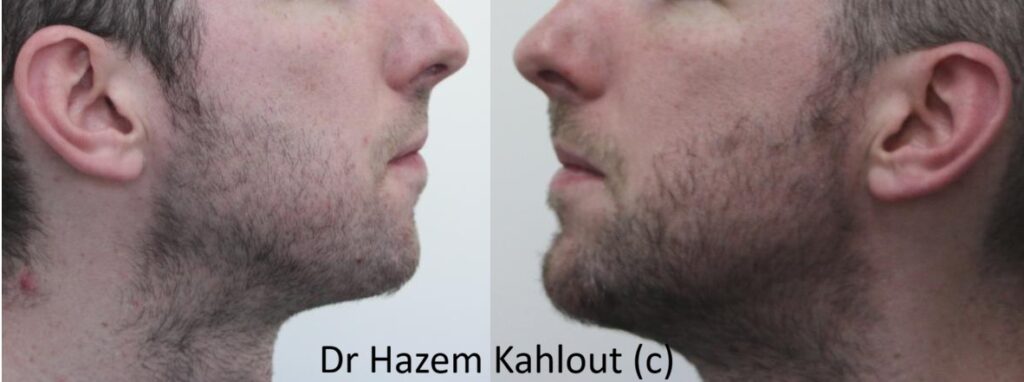
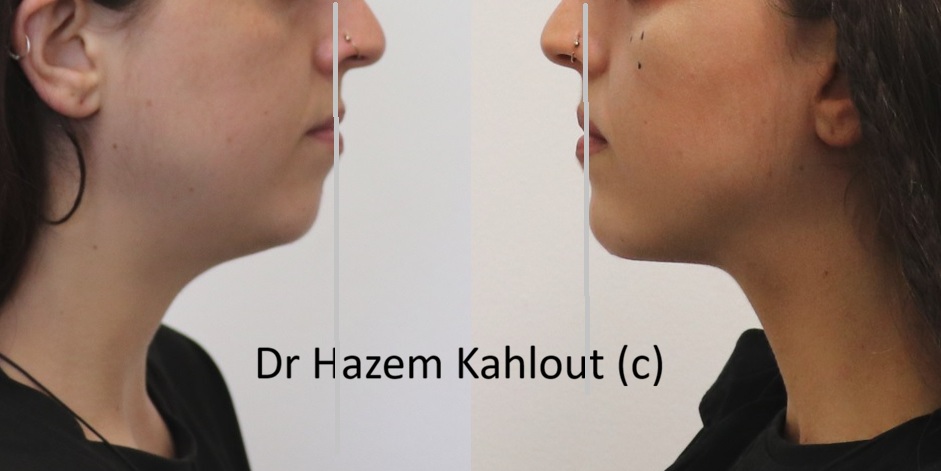
These photos show results from my own patients, who have kindly agreed to share them. Every face is different, so your result will depend on your own anatomy, and I’ll show you what’s realistic for you at your consultation.
Recovery and aftercare
Downtime is usually minimal. You may have mild swelling, tenderness or a small bruise for a few days, and most people go back to work the same day.
The first 48 hours matter most, because that’s when the filler settles into the surrounding tissue. Many of us rest our chin on our hands without thinking, so during that time:
- avoid pressing on, rubbing or leaning on your chin
- keep the area clean
- avoid strenuous exercise for the first 24 hours
Side effects and filler migration
Swelling, tenderness and bruising are the most common side effects, and they settle within days. Less commonly, filler can feel lumpy or look uneven, and my post on lumps after filler explains how these are treated.
The chin takes more pressure than most of the face, from hands touching and leaning on it, so filler there can move if it isn’t placed well. Choosing the right filler and the right depth makes migration much less likely, and so does looking after it in the first 48 hours. My post on filler migration explains more about why filler moves and how it’s corrected.
The most serious risk, though rare, is filler blocking a blood vessel. The chin carries less risk than areas such as the nose, but no area is free of it, which is why chin filler should only be done by a doctor who knows the anatomy and can recognise and treat a complication straight away.
Your review
I review you at about a month, once any swelling has settled and the filler has fully bedded in. If a small adjustment is needed then, we’ll discuss it.
How long does chin filler last?
In my experience, in the chin:
- hyaluronic acid filler lasts around 8 to 10 months
- Radiesse lasts around 12 to 14 months
- Ellansé lasts two years or more
How long yours lasts also depends on your metabolism, how active you are and how much filler you have.
Chin filler prices in Dublin
| Treatment Filler | Price From |
|---|---|
| Hyaluronic acid chin filler (1ml) | €450 |
| Radiesse (1.5ml) | €650 |
| Ellansé M | €850 |
The final cost depends on the filler and the amount you need, which I’ll confirm at your consultation. You’ll find every price on our cosmetic injection price list.
Chin filler FAQs
How much does chin filler cost in Ireland?
At our clinic, chin filler starts from €450 for hyaluronic acid filler, €650 for Radiesse and €850 for Ellansé.
How long does chin filler last?
Around 8 to 10 months for hyaluronic acid filler, 12 to 14 months for Radiesse and two years or more for Ellansé.
Is chin augmentation the same as chin filler?
Chin augmentation means making the chin bigger or more prominent. It can be done with filler, which is what I offer, or with surgery.
Does chin filler hurt?
Most people find it very manageable. I can use a nerve block to numb the area, along with cool packs.
Can chin filler be dissolved?
Hyaluronic acid filler can be dissolved if needed. Radiesse and Ellansé can’t, which is why I only use them when we’re confident about the result.
Is chin filler suitable for men?
Yes. Many of my chin patients are men who want a wider, stronger chin, and men usually need a little more filler than women.
Can chin filler fix a double chin?
It can make a double chin look less obvious by improving the profile, but it doesn’t remove fat. For that, neck liposuction or fat-dissolving injections are the right treatments.
Is chin filler better than a chin implant?
It depends on your anatomy. Filler avoids an operation and can be shaped to your chin. A short lower jaw or a bite problem needs surgery instead, and I’ll tell you honestly which suits you.
If you’d like to know whether chin filler could balance your profile, book a consultation at our clinic in Castleknock, Dublin 15. I’ll measure your profile, show you what’s realistic and tell you honestly whether filler or surgery is the better option.
Related Treatments
References
- Arroyo HH, Olivetti IP, Lima LFR, Jurado JRP. Clinical evaluation for chin augmentation: literature review and algorithm proposal. Brazilian Journal of Otorhinolaryngology, 2016.


