Medically reviewed and updated by Dr Hazem Kahlout, November 2026
Most of us have fat we’d happily lose, and places where we’ve lost volume we’d like back. Fat transfer moves it from one to the other. A small amount of your own fat is taken from an area such as the tummy or thighs, carefully prepared, and placed where it’s needed: the face, the hands, the breasts or the buttocks.
Fat transfer is also known as lipofilling or fat grafting. Because it uses your own tissue, the result looks and feels natural, and the fat that settles in stays for good. I carry out every fat transfer myself at Castleknock Cosmetic Clinic, and patients come to us from across Ireland. Here’s how it works, how much of the fat survives, and what recovery and costs look like.
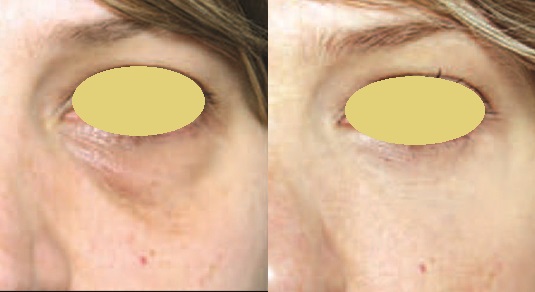
Fat transfer to the undereyes before and after
Dr Hazem Kahlout
Fat transfer at a glance
| Face | Body (breasts or buttocks) | |
|---|---|---|
| Anaesthesia | Local anaesthetic | Local anaesthetic, with sedation available |
| Procedure time | About 90 minutes | About 2 hours |
| Sessions | Usually one or two | 20% to 50% choose a second |
| Fat that survives | 50% to 70% on average | 50% to 70% on average |
| Time off work | 7 to 10 days | 1 week |
| Price | From €2,950 | From €4,950 |
Why use your own fat?
Fat has several advantages over manufactured fillers and implants:
- it’s your own tissue, so there’s nothing foreign for the body to react to
- the fat that survives becomes permanent living tissue
- it looks and feels natural, moving and softening like the tissue around it
- the area the fat is taken from becomes slimmer
The trade-off is that it involves a minor procedure to harvest the fat, a longer recovery than filler, and a result that’s slightly less predictable, because not all the fat survives. My guide to dermal fillers explains the alternative.

How much of the fat survives?
This is the question I’m asked most, and the honest answer is that not all of it stays. On average, 50% to 70% of transferred fat survives long term. Over the first three to six months, the body reabsorbs the cells that didn’t manage to build a new blood supply. By about six months, the fat that remains has become part of your own tissue. From then on it behaves like the rest of your body fat, so it can grow or shrink if your weight changes.
How often a second session is needed depends on the area:
- The face needs only a small amount of fat, usually 30 to 60ml in total, placed in tiny droplets. Results are predictable, and most people need only one session.
- The breasts and buttocks need much larger volumes. The tissue can only take so much fat at once before the pressure cuts off the blood supply the new fat needs. For that reason, 20% to 50% of patients choose a second session, and an increase of more than one cup size usually needs sessions three to six months apart.
How I prepare the fat
The way fat is taken and prepared affects how much of it survives. I use VASER to gently loosen the fat before harvesting it, which makes it easier to remove with less trauma. For the face, I take it with a syringe. For larger areas, I use gentle suction.
The fat is then processed with the Tulip system, a closed system that separates it into different textures without harsh chemical washing or spinning. Each texture has a different job.
Microfat
Microfat is made of tiny clusters of intact fat cells, fine enough to pass through a very small cannula. Because the clusters are so small, nutrients and oxygen reach them quickly while new blood vessels grow, so more of the fat tends to survive, typically 50% to 80%. I use microfat for delicate areas of the face, such as the temples, the cheeks and the lines beside the nose, and most people need only one session.
Nanofat
Nanofat is processed further, until it becomes a liquid. It doesn’t add volume, because it contains no intact fat cells. Instead, it’s rich in stromal cells and growth factors, which are thought to stimulate collagen and improve the quality of thin or damaged skin. I use it for fine lines, dark circles and scarring, usually over two or three sessions a few months apart. My nano fat page explains it in detail.
Where can fat be transferred?
Face
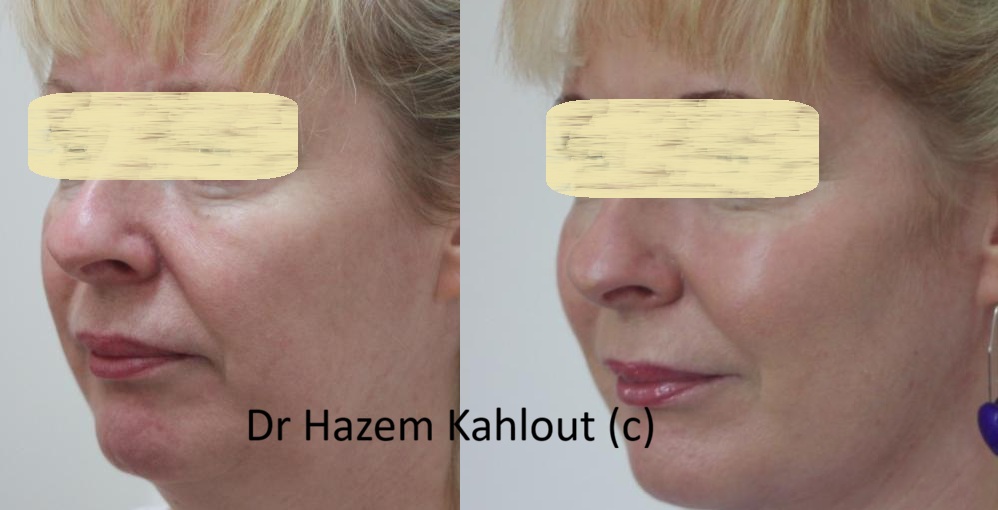
Fat can restore volume to the cheeks, temples, jawline and chin, soften the lines from the nose to the mouth, and add fullness to the lips. Many people choose it as a longer-lasting, natural alternative to filler, sometimes as part of a liquid facelift.
Under the eyes
For hollow under-eyes and thin skin, microfat and nanofat can be a good alternative to filler. My nano fat and tear trough pages explain who suits which.
Hands
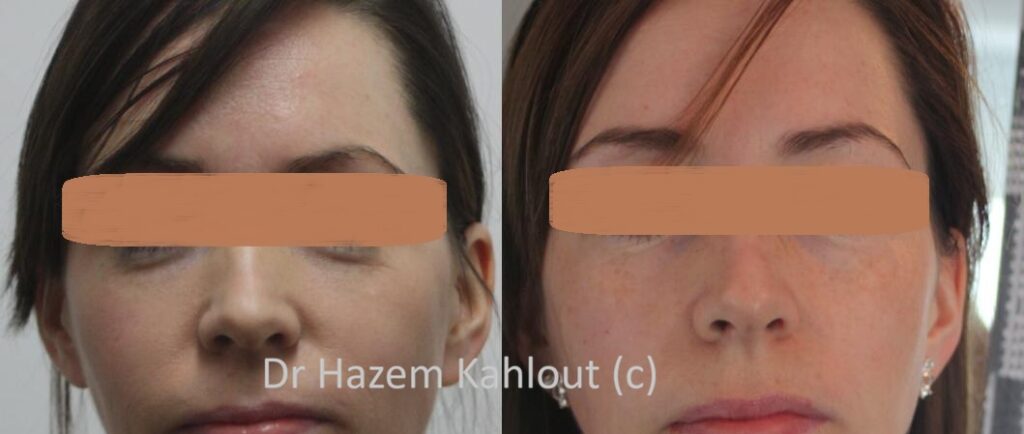
Ageing hands lose fat, so the veins and tendons show. Fat transfer restores a softer, fuller look to the backs of the hands.
Breasts
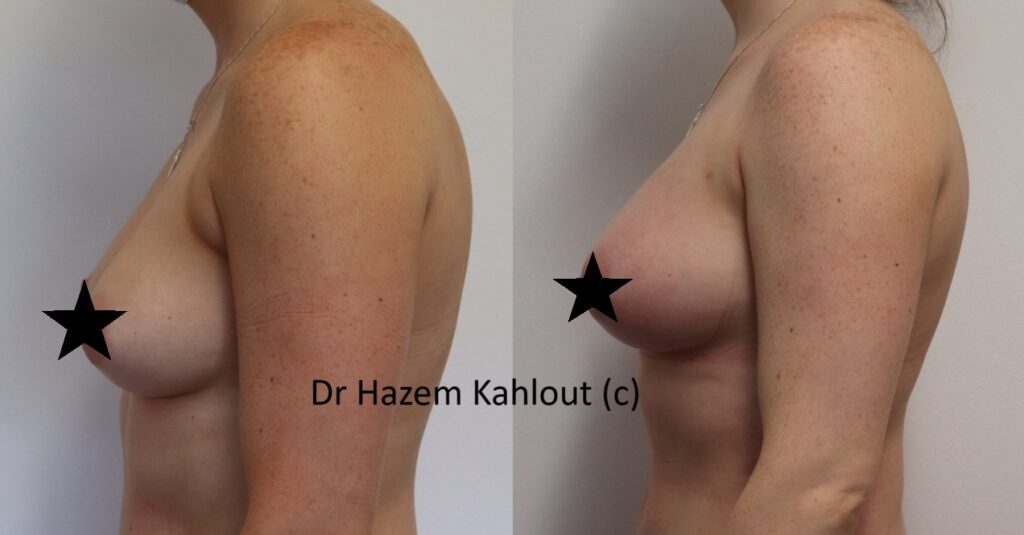
Fat transfer can give a modest, natural increase in breast size, improve shape, or correct differences between the two sides, without an implant. Larger changes usually need more than one session.
Buttocks and hip dips
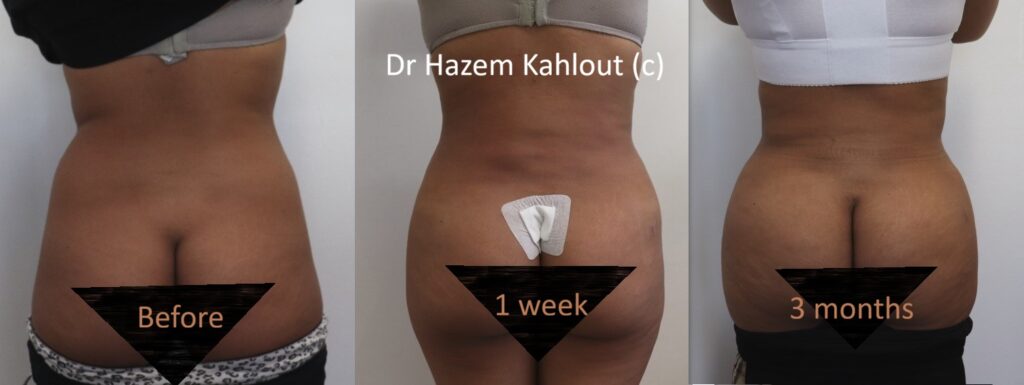
Fat can add volume and shape to the buttocks and fill hip dips, while slimming the areas it’s taken from. For slim people without enough fat to spare, a Sculptra butt lift may be the better choice.
Correcting irregularities after liposuction
Dents or uneven areas left by previous liposuction can often be smoothed by transferring a little fat into them.
Who is fat transfer suitable for?
You’re likely to suit fat transfer if you:
- have enough fat to spare in an area such as the tummy, flanks or thighs
- have a stable weight, since transferred fat changes with your weight
- are in good general health
- understand that not all the fat will survive and a second session may be needed
Smoking reduces how much fat survives, so it’s best to stop well before and after treatment.
Your procedure
Your first appointment is a consultation, where I examine the area you’d like treated and the areas the fat could come from, and explain what’s realistic.
On the day, I numb both the harvest area and the treatment area with local anaesthetic. For larger body treatments, I can also offer sedation with relaxing tablets. Facial fat transfer takes about 90 minutes, and body treatments about two hours. Large-volume transfers to the breasts or buttocks are usually combined with VASER liposuction of the harvest area.
Recovery after facial fat transfer
Because only a small amount of fat is used, recovery from facial fat transfer is mostly about appearance rather than discomfort.
Gentle walking is encouraged from the first day. Light cardio is fine after one to two weeks, but avoid strenuous exercise and heavy lifting for three to four weeks.
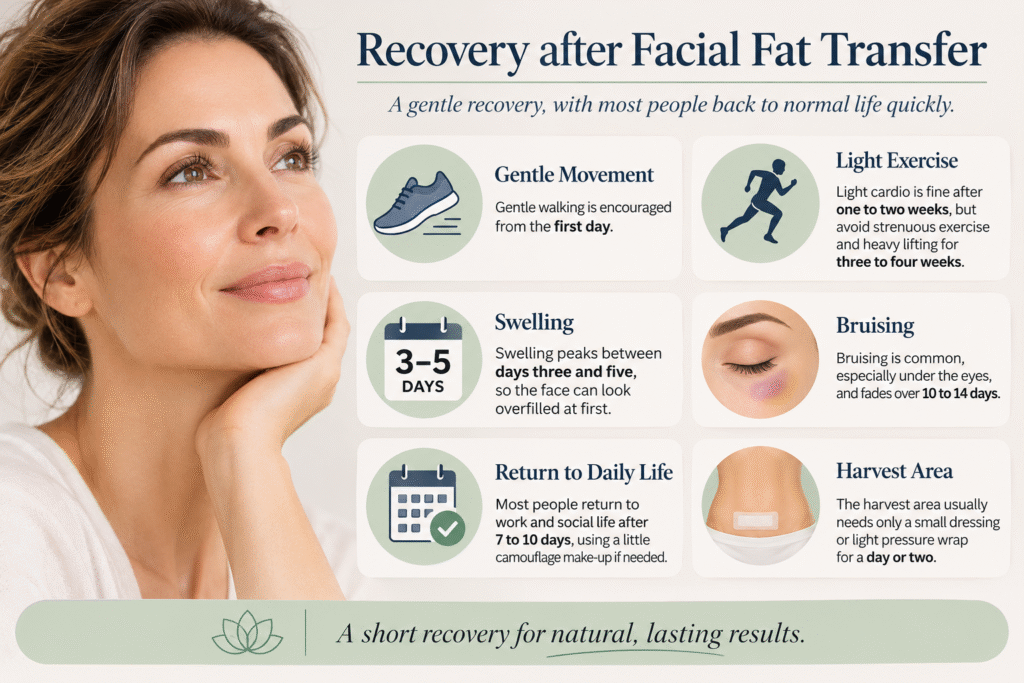
Swelling peaks between days three and five, so the face can look overfilled at first.
Bruising is common, especially under the eyes, and fades over 10 to 14 days.
Most people return to work and social life after 7 to 10 days, using a little camouflage make-up if needed.
The harvest area usually needs only a small dressing or light pressure wrap for a day or two.
Recovery after fat transfer to the breasts or buttocks
Large-volume fat transfer involves more liposuction, so recovery is more physical.
Walking is important from the first day to prevent blood clots. Low-impact cardio is usually fine from three to four weeks, and a full gym routine from about six weeks. Heavy squats and exercises that press on the buttocks may need to wait longer.
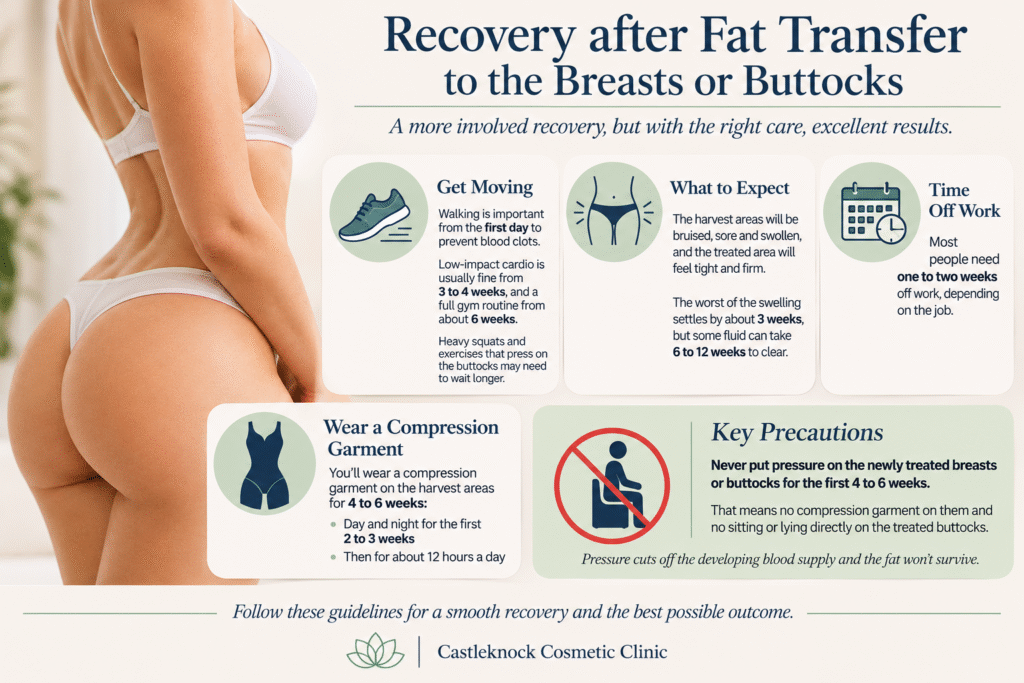
The harvest areas will be bruised, sore and swollen, and the treated area will feel tight and firm. The worst of the swelling settles by about three weeks, but some fluid can take 6 to 12 weeks to clear.
Most people need one to two weeks off work, depending on the job.
You’ll wear a compression garment on the harvest areas for four to six weeks: day and night for the first two to three weeks, then for about 12 hours a day.
Never put pressure on the newly treated breasts or buttocks for the first four to six weeks. That means no compression garment on them and no sitting or lying directly on the treated buttocks. Pressure cuts off the developing blood supply and the fat won’t survive.
Risks and side effects
Fat transfer is a medical procedure, and I’ll go through the risks with you in detail before you decide. The main ones are:
- Firm lumps and oil cysts. If a small cluster of fat cells doesn’t establish a blood supply, the cells die. This can leave a firm lump of scar tissue, or an oil cyst, a harmless pocket of liquefied fat. They’re usually harmless, but some can be felt under the skin, and if one becomes bothersome it can be drained or treated with a steroid injection in the clinic.
- Asymmetry. Fat is rarely reabsorbed evenly. One side may keep 70% of its fat and the other 50%, so a small difference between the two sides is common, and movement or your natural anatomy can make it more noticeable.
- Irregularities at the harvest site. If fat is taken unevenly, or the skin doesn’t tighten smoothly over the area, there can be dents, rippling or dimpling where the fat came from, such as the tummy or thighs. Careful, even harvesting reduces this risk.
- Needing a second session. For larger areas, fat transfer is often a staged process, so be prepared that reaching your goal may take a second procedure three to six months later.
- Infection, which is rare with a sterile technique.
Fat transfer to the breasts and breast screening
When transferred fat cells don’t survive, they can leave tiny flecks of calcium, called microcalcifications, in the breast. In the past there was concern that these could be confused with signs of breast cancer on a mammogram. Modern imaging allows experienced radiologists to tell the smooth, rounded calcifications left by fat apart from the irregular, clustered patterns linked to cancer.
Even so, I ask every patient to have a baseline mammogram, and ideally a breast ultrasound, before treatment, so there’s a clear picture of the breasts beforehand. Afterwards, always tell the radiographer and radiologist at your screening that you’ve had fat transfer, so they can read your scans in the right context.
Fat transfer to the buttocks: the essential safety rule
With fat transfer to the buttocks, one rule matters above all. The fat must go only into the fatty layer directly under the skin, and never into or beneath the buttock muscle. Deep in the muscle there are large blood vessels, and fat that enters them can travel to the heart and lungs, causing a fat embolism, a rare but potentially fatal complication.
I follow current safety guidance, using a large, blunt-tipped cannula angled to keep the fat in the layer above the muscle. If a clinic can’t explain clearly how it keeps fat out of the muscle, that’s a reason to look elsewhere.
Fat transfer prices
Fat transfer to the face starts from €2,950, with a reduced price for a second session if one is needed. Fat transfer to the breasts or buttocks, which includes VASER liposuction of the harvest area, starts from €4,950. I’ll give you an exact quote at your consultation. You’ll find every price on our price list.
Fat transfer FAQs
How much does fat transfer cost in Ireland?
At our clinic, facial fat transfer starts from €2,950, and fat transfer to the breasts or buttocks with VASER liposuction starts from €4,950.
How much of the fat survives?
On average, 50% to 70%. The rest is reabsorbed over the first three to six months.
Is fat transfer permanent?
The fat that survives the first six months becomes permanent living tissue. It can change with your weight, and your face and body will keep ageing naturally.
How long is the recovery?
Most people return to work 7 to 10 days after facial fat transfer, and one to two weeks after fat transfer to the breasts or buttocks.
Is fat transfer better than filler?
It depends. Fat lasts longer and feels completely natural, but it involves a minor procedure and a longer recovery. Filler is quicker, with no recovery time, but needs repeating. I’ll help you weigh it up.
Can fat transfer be done under the eyes?
Yes. Microfat and nanofat can restore volume and improve thin skin under the eyes, and are a good alternative to filler for some people.
Can fat transfer increase my breast size?
Yes, by a modest amount, usually up to about one cup size per session. Larger increases need more than one session, three to six months apart.
Is fat transfer painful?
The harvest and treatment areas are numbed with local anaesthetic, and sedation is available for larger areas. Afterwards, expect some soreness, especially at the harvest site after body treatments.
Is fat transfer to the buttocks safe?
It’s safest when the fat is placed only in the layer under the skin, never in the muscle. That’s the rule I always follow, and it’s the most important question to ask any clinic.
Does fat transfer affect breast screening?
It can leave small calcifications that show on a mammogram, but radiologists can usually tell them apart from signs of cancer. Have a baseline mammogram before treatment and always mention your fat transfer at screening.
If you’d like to know whether fat transfer could help you, book a consultation at our clinic in Castleknock, Dublin 15. I’ll assess where you’ve lost volume and where the fat could come from, and tell you honestly what’s realistic.
References